

NetSuite ERP vs SAP Business One_ A Comprehensive Comparison

NetSuite ERP vs SAP Business One: A Comprehensive Comparison

NetSuite ERP vs SAP Business One: A Comprehensive Comparison

NetSuite ERP vs SAP Business One_ A Comprehensive Comparison

Enterprise Resource Planning (ERP) systems are critical tools for modern businesses, offering streamlined processes, enhanced efficiency, and a unified platform to manage diverse business operations. With the global ERP software market projected to soar to$78.4 billion by 2026, the growing reliance on these systems reflects their indispensable role in today’s business landscape. Approximately 38% of organizations report improved customer responsiveness due to ERP systems, highlighting their importance in driving agility and adaptability.

In the vast and competitive ERP market, NetSuite and SAP Business One are two leading platforms that cater to a wide range of business needs. Whether you are a startup, a mid-sized company, or a large enterprise, choosing the right ERP solution is crucial to your business’s success. This comprehensive comparison will explore the key features, benefits, and use cases of NetSuite and SAP Business One to help you make an informed decision.

Understanding NetSuite ERP

NetSuite, a product of Oracle, is a cloud-based ERP solution that has become a popular choice for businesses of all sizes. With a customer base of over 28,000 businesses worldwide, NetSuite has demonstrated its ability to cater to various industry verticals, including retail, manufacturing, distribution, and professional services.

Key Features of NetSuite ERP:

  • Cloud-Based Architecture: NetSuite’s cloud-based nature allows businesses to access real-time data from anywhere, anytime. This accessibility is particularly beneficial for companies with distributed teams or multiple locations, as it ensures seamless collaboration and informed decision-making.
  • Comprehensive Suite of Applications: NetSuite offers a unified platform with integrated applications for financial management, CRM, e-commerce, inventory management, human capital management (HCM), and more. This all-in-one approach eliminates the need for multiple disparate systems, reducing complexity and improving efficiency.
  • Scalability and Flexibility: NetSuite’s architecture supports seamless scalability, making it an ideal choice for growing businesses. As organizations expand, NetSuite can easily accommodate increasing user numbers, data volumes, and functional requirements without significant disruptions.
  • Industry-Specific Solutions: NetSuite provides tailored solutions for various industries, ensuring that businesses have access to features and functionalities that meet their unique needs. For example, its retail solution includes omnichannel commerce capabilities, while its manufacturing solution offers advanced production management tools.
  • Real-Time Reporting and Analytics: NetSuite’s built-in reporting and analytics tools enable businesses to gain valuable insights into their operations. With customizable dashboards and real-time data, decision-makers can monitor key performance indicators (KPIs) and make data-driven decisions.

Benefits of NetSuite ERP:

  • Reduced IT Infrastructure Costs: As a cloud-based solution, NetSuite eliminates the need for on-premise servers and hardware, resulting in lower IT infrastructure and maintenance costs.
  • Automatic Software Updates: NetSuite’s cloud-based architecture ensures that businesses always have access to the latest features and security updates without the need for manual upgrades.
  • Enhanced Accessibility: With NetSuite, businesses can access their ERP system from any device with an internet connection, providing greater flexibility and mobility for employees.

Understanding SAP Business One

SAP Business One is an ERP solution specifically designed for small and medium-sized enterprises (SMEs). Holding a 5.08% market share in the ERP landscape, SAP Business One has established itself as a trusted choice for organizations seeking a comprehensive and customizable business management platform.

Key Features of SAP Business One:

  • On-Premise and Cloud Deployment Options: SAP Business One offers flexibility in deployment, allowing businesses to choose between on-premise and cloud-based options. This flexibility caters to organizations with different IT infrastructure preferences and scalability requirements.
  • Modular Structure: SAP Business One’s modular design enables businesses to customize their ERP system by adding or removing modules based on their specific needs. This structure allows for scalability as the business grows and evolves.
  • Robust Core Functionalities: SAP Business One provides a wide range of functionalities, including financial management, sales, CRM, inventory control, production planning, and purchasing. These core features are essential for businesses seeking to manage their operations efficiently.
  • Industry-Specific Add-Ons: SAP Business One offers industry-specific editions and add-ons that cater to the unique requirements of various sectors, such as manufacturing, retail, and distribution.
  • Comprehensive Reporting Tools: SAP Business One includes built-in reporting tools that provide businesses with insights into their operations. Customizable reports and dashboards allow decision-makers to monitor KPIs and track performance.

Benefits of SAP Business One:

  • Customization Capabilities: SAP Business One’s modular structure allows businesses to tailor their ERP system to meet their specific needs. This customization is particularly beneficial for SMEs with unique requirements.
  • Control Over IT Infrastructure: With the option for on-premise deployment, businesses can maintain greater control over their IT infrastructure, ensuring data security and compliance with industry regulations.
  • Scalability for SMEs: SAP Business One is designed to scale with growing businesses, providing the flexibility to add new modules and functionalities as needed.

Head-to-Head Comparison

In this section, we will compare NetSuite and SAP Business One across various critical aspects to help you understand their differences and similarities

Deployment Models

  • NetSuite: NetSuite is a purely cloud-based solution, which means businesses do not need to invest in on-premise servers or hardware. This model offers several advantages, including reduced IT infrastructure costs, automatic software updates, and enhanced accessibility. NetSuite’s cloud-first approach is particularly beneficial for organizations seeking to minimize upfront investments and maximize operational efficiency.
  • SAP Business One: SAP Business One provides flexibility with both on-premise and cloud-based deployment options. On-premise deployment offers greater control over IT infrastructure, making it suitable for businesses with stringent security and compliance requirements. Cloud deployment shares benefits with NetSuite’s model, offering lower upfront costs and easier scalability. The choice between the two depends on a business’s specific IT strategy and preferences.

Scalability

  • NetSuite: NetSuite’s cloud-based architecture enables seamless scalability, allowing businesses to grow without worrying about IT infrastructure constraints. As businesses expand, NetSuite can easily adapt to increasing user numbers, data volumes, and functional requirements. This scalability is particularly valuable for fast-growing companies and global organizations.
  • SAP Business One: SAP Business One is designed to scale with small and medium-sized businesses (SMEs). While it offers scalability, larger enterprises may need to invest in additional modules and resources to accommodate growth. On-premise deployments might involve more complex infrastructure upgrades during growth phases, making scalability a more involved process compared to NetSuite.

Core Functionalities

  • Financials: Both NetSuite and SAP Business One offer robust financial management capabilities, including general ledger, accounts receivable, accounts payable, fixed asset management, and financial reporting. However, NetSuite often excels in financial consolidation and multi-currency management for global organizations with complex financial structures. SAP Business One provides solid financial management features but might require additional modules for advanced financial consolidation needs.
  • CRM: NetSuite generally provides a more comprehensive CRM solution with features like sales force automation, marketing automation, and customer relationship management tools. This makes NetSuite a strong contender for businesses seeking to streamline sales processes, nurture customer relationships, and drive marketing campaigns. While SAP Business One offers CRM functionalities, NetSuite often provides a more integrated and feature-rich CRM experience.
  • Inventory Management: Both ERPs offer inventory tracking, purchasing, and order management. However, NetSuite’s strength lies in its supply chain management capabilities, making it suitable for businesses with complex supply chains, multiple warehouses, and intricate inventory management requirements. SAP Business One also provides robust inventory management but might require additional modules for advanced supply chain functionalities.
  • E-commerce: NetSuite offers a native e-commerce platform with seamless integration into the core ERP system, making it a preferred choice for businesses with significant online sales. This integration ensures real-time inventory updates, order management, and fulfillment. SAP Business One provides basic e-commerce capabilities but might require third-party integrations for larger-scale online operations, potentially leading to more complex setups.
  • Human Capital Management (HCM): While both ERPs offer core HCM functionalities like payroll, time and attendance, and employee management, NetSuite typically provides a more comprehensive HCM suite with features like talent management, benefits administration, and workforce analytics. This makes NetSuite a suitable option for organizations with complex HR requirements and a focus on employee data management.

 User Interface and Experience

  • NetSuite: NetSuite is often praised for its intuitive user interface and ease of navigation. Its modern design and user-friendly features contribute to faster user adoption and higher user satisfaction. The platform’s customization options also allow businesses to tailor the interface to meet their specific needs, further enhancing the user experience.
  • SAP Business One: SAP Business One also offers a user-friendly interface, but it might require more extensive user training, especially for complex functionalities. The platform’s modular structure allows businesses to customize the interface to some extent, but it may not be as intuitive as NetSuite for new users.

Industry Focus

  • NetSuite: NetSuite provides industry-specific solutions tailored to verticals like retail, manufacturing, distribution, and professional services. These solutions include features and functionalities designed to meet the unique needs of each industry, making NetSuite a versatile option for businesses across various sectors.
  • SAP Business One: SAP Business One offers industry-specific editions and add-ons that cater to the unique requirements of various sectors. While it has a broader industry focus, its customization options allow businesses to tailor the system to meet their specific needs.

Pricing and Licensing

  • NetSuite: NetSuite primarily uses a subscription-based pricing model, offering flexibility and scalability. Businesses can choose from different pricing tiers based on their needs, with the option to add or remove features as required. This pricing model is ideal for businesses seeking a predictable cost structure and the ability to scale as they grow.
  • SAP Business One: SAP Business One offers both perpetual and subscription-based licensing options, catering to different purchasing preferences. The perpetual license involves a one-time upfront cost, while the subscription model provides ongoing access to the software for a monthly or annual fee. The choice between the two depends on a business’s budget and long-term financial strategy.

Integration Capabilities

  • NetSuite: NetSuite’s cloud-based architecture and open API facilitate seamless integration with other cloud applications, making it an ideal choice for businesses with existing cloud-based systems. The platform’s extensive integration capabilities enable businesses to connect with third-party applications, enhancing overall functionality and streamlining operations.
  • SAP Business One: SAP Business One might require additional middleware or custom development for complex integrations, particularly for businesses with on-premise deployments. While the platform offers integration capabilities, it may not be as seamless as NetSuite, especially for businesses with diverse IT environments.

In-Depth Feature Comparison

  • Financials

Both NetSuite and SAP Business One offer comprehensive financial management capabilities, including general ledger, accounts receivable, accounts payable, fixed asset management, and financial reporting. However, NetSuite often excels in financial consolidation and multi-currency management, making it a preferred choice for global organizations with complex financial structures. SAP Business One provides solid financial management features but might require additional modules for advanced financial consolidation needs.

  • CRM

NetSuite generally provides a more comprehensive CRM solution with features like sales force automation, marketing automation, and customer relationship management tools. This makes NetSuite a strong contender for businesses seeking to streamline sales processes, nurture customer relationships, and drive marketing campaigns. While SAP Business One offers CRM functionalities, NetSuite often provides a more integrated and feature-rich CRM experience.

  • Inventory Management

Both ERPs offer inventory tracking, purchasing, and order management. However, NetSuite’s strength lies in its supply chain management capabilities, making it suitable for businesses with complex supply chains, multiple warehouses, and intricate inventory management requirements. SAP Business One also provides robust inventory management but might require additional modules for advanced supply chain functionalities.

  • E-commerce

NetSuite offers a native e-commerce platform with seamless integration into the core ERP system, making it a preferred choice for businesses with significant online sales. This integration ensures real-time inventory updates, order management, and fulfillment. SAP Business One provides basic e-commerce capabilities but might require third-party integrations for larger-scale online operations, potentially leading to more complex setups.

  • Human Capital Management (HCM)

While both offer core HCM functionalities like payroll, time and attendance, and employee management, NetSuite typically provides a more comprehensive HCM suite with features like talent management, benefits administration, and workforce analytics. This makes NetSuite a suitable option for organizations with complex HR requirements and a focus on employee data management.

When to Choose NetSuite vs. SAP Business One

Choosing the right ERP solution depends on various factors, including business size, industry, budget, and growth plans. Here’s a guide to help you decide:

  • When to Choose NetSuite: NetSuite is ideal for businesses seeking a cloud-first approach, scalability, and a broad suite of integrated functionalities. Its strengths lie in its ability to accommodate rapid growth, handle complex business processes, and provide a unified platform for various departments. NetSuite is particularly well-suited for organizations with a global footprint or those operating in highly competitive industries.
  • When to Choose SAP Business One: SAP Business One is suitable for small and medium-sized enterprises (SMEs) prioritizing on-premise deployment, customization, and a strong focus on core ERP functionalities. Businesses with specific industry needs or those requiring a high degree of control over their IT infrastructure might find SAP Business One a suitable option

Conclusion

Selecting the right ERP system is a critical decision for business success. By carefully evaluating NetSuite and SAP Business One based on factors like deployment model, scalability, core functionalities, user experience, industry focus, pricing, and integration capabilities, businesses can make informed decisions that drive growth and efficiency.

Here’s a quick recap to help you choose:

  • Cloud-first approach, scalability, and broad functionalities? NetSuite might be your ideal fit.
  • Prioritizing on-premise deployment, customization, and core ERP functionalities for SMEs? Consider SAP Business One.

Remember, the best ERP for your business depends on your specific needs and long-term goals.

Ready to take the next step? Contact ABSOL for a free consultation. Our ERP experts can help you assess your business requirements, compare leading solutions like NetSuite and SAP Business One in detail, and identify the perfect fit to propel your organization forward.

Don’t wait to unlock the potential of a robust ERP system!

Maximizing Efficiency with Oracle NetSuite Project Management Module

Maximizing Efficiency with Oracle NetSuite Project Management Module

Maximizing Efficiency with Oracle NetSuite Project Management Module

Maximizing Efficiency with Oracle NetSuite Project Management Module


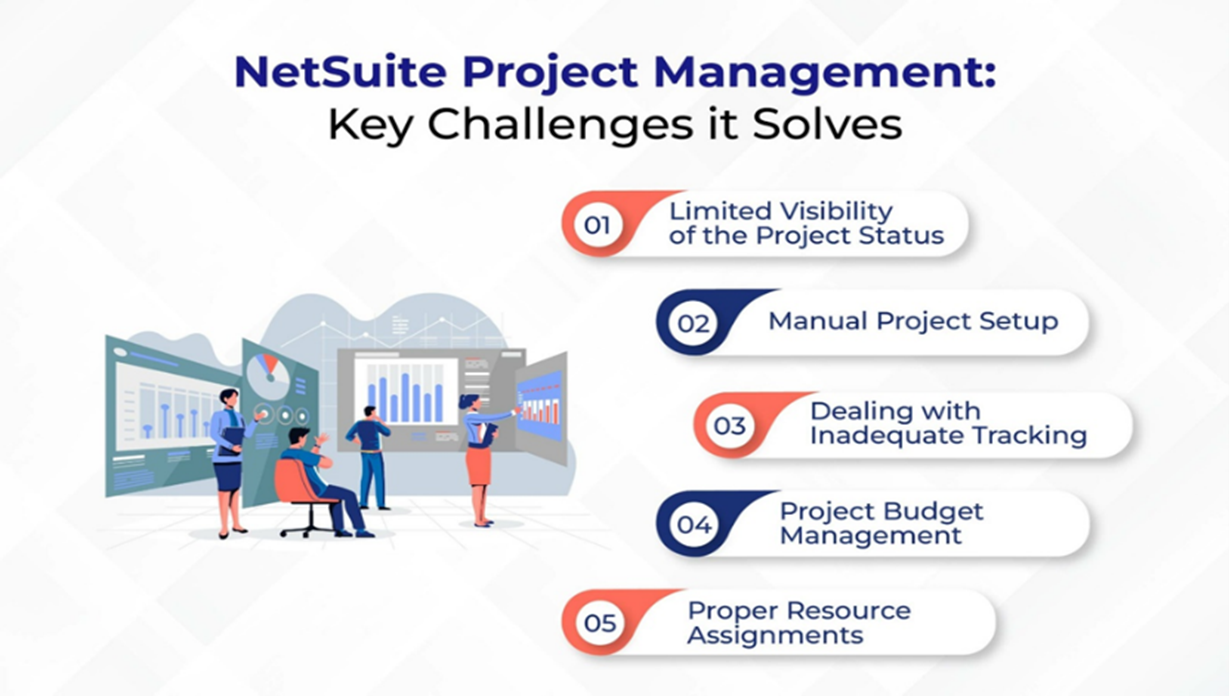
According to Medium Corporation Research, a staggering 72% of projects fail to meet their original goals, highlighting the critical need for advanced tools. For project-based businesses that have to deal with the difficulties of managing budgets, deadlines, and resource optimization, traditional methods are usually unsuccessful. The fact that just 29% of projects were successfully finished on schedule and within budget highlights the necessity for effective tools. Project management is revolutionized by NetSuite, a cloud-based ERP system, which integrates and automates critical tasks.  Let’s explore how NetSuite helps businesses achieve operational excellence and seamless project management.

Why Efficient Project Management Matters

Effective project management is the cornerstone of success in today’s competitive landscape. Traditional methods, reliant on spreadsheets and disparate systems, create challenges that hinder project delivery. Project managers today wear many hats, overseeing multiple projects simultaneously. 85% of project managers oversee numerous projects at once. As projects get more complicated and time restrictions tighten, organizations need a reliable system that can collect data, automate operations, and provide actionable insights for data-driven decision-making.

Common Challenges Faced in Project Management

Project management is filled with complications and challenges that could affect project completion. Understanding these challenges is critical for developing effective solutions and increasing overall project results.

  • Poor Communication: One of the most typical difficulties is a breakdown in communication between team members and stakeholders. Miscommunication can cause misunderstandings, delays, and disputes, eventually jeopardizing project success. Effective communication tools and procedures are critical for ensuring everyone is on the same page.
  • Inadequate Resource Management: It is often difficult to allocate resources efficiently. Over or under allocating resources might result in project delays and higher expenses. Proper resource management ensures that the necessary resources are available at the appropriate moment.
  • Unrealistic Deadlines: Setting unreasonable deadlines can place tremendous strain on the project team, resulting in burnout and poor quality. It is critical to establish feasible deadlines based on detailed project planning and realistic estimates of the scope of work.
  • Inadequate Risk Management: Projects frequently face unexpected risks that might hinder development. Inadequate risk management practices may leave the team unprepared to address these concerns. Identifying possible hazards and devising mitigation strategies are crucial to project resilience.
  • Budget Overruns: Keeping projects under budget is an ongoing issue. Poor budgeting and unexpected costs can cause severe financial distress. Regular budget reviews and precise cost estimation are essential for maintaining financial management.

NetSuite: Your Project Management Powerhouse

The comprehensive toolbox offered by the cloud-based ERP system NetSuite is tailored to meet the unique requirements of project-based businesses. Resource management and project planning are just two of the many capabilities that NetSuite delivers on a single platform that breaks down barriers and promotes collaboration. With NetSuite, businesses can optimize project workflows and increase profitability because to its customizable dashboards, automation tools, and real-time data access. Interestingly, productivity increases by 20–25% in companies with linked workers, which NetSuite enables with its integrated strategy. NetSuite empowers project-based businesses to achieve operational excellence and seamless project management. Here’s how:

  • Resource Management: NetSuite simplifies resource allocation by providing a clear view of team member skills and availability. You can efficiently assign the right people to the right tasks, optimizing project resource utilization.
  • Project Planning & Budgeting: NetSuite allows for detailed project planning with clear milestones and deadlines. Built-in budgeting tools help set realistic financial parameters and track expenses against those budgets, ensuring projects stay on track financially.
  • Automation Powerhouse: Automate repetitive tasks like approvals, notifications, and data entry, freeing up valuable time for project managers to focus on strategic initiatives.
  • Real-Time Data & Visibility: Gain instant access to project data, allowing for proactive decision-making. Identify and address roadblocks before they derail progress, keeping projects on schedule and within budget.
  • Customizable Dashboards: Tailor dashboards to visualize key metrics relevant to your specific role or project needs. Stay informed on project progress, resource allocation, and budget adherence at a glance.

Benefits of Using NetSuite for Project-Based Businesses

NetSuite goes beyond traditional project management tools, offering a multitude of benefits for project-based businesses:

  • Enhanced Project Visibility: Real-time data access empowers project managers to proactively identify and address issues, ensuring projects stay on track.
  • Improved Resource Allocation: Efficient resource allocation through skills-based matching optimizes project resource utilization and team productivity.
  • Streamlined Workflows: Automate repetitive tasks to free up valuable time for project managers and team members to focus on strategic initiatives.
  • Accurate Time Tracking: Track time spent on projects accurately, ensuring accurate billing and payroll management, and helping identify resource bottlenecks for optimization.
  • Integrated Financial Management: Seamless integration with financial systems ensures accurate budgeting, expense tracking, and improved financial control throughout the project lifecycle.
  • Enhanced Collaboration: A centralized platform for communication, document sharing, and task management fosters seamless collaboration and keeps everyone aligned.

Key Features of NetSuite for Enhanced Project Management

The range of features that NetSuite provides, each tailored to meet the specific needs of project-based businesses, guarantees an efficient and streamlined project management process.

Time Tracking and Resource Allocation: NetSuite has capabilities for correctly tracking time spent on project-related tasks. This tool enables organizations to track labor expenditures in real time, ensuring that resources are appropriately deployed and project timelines are met. Effective resource allocation helps to maximize production while decreasing idle time, resulting in improved project outputs.

Project Planning and Budgeting: NetSuite allows organizations to construct thorough project plans that include all activities, dates, and milestones. The budgeting tools allow for setting realistic financial parameters and tracking expenses against these budgets. This proactive financial management helps to avoid cost overruns and keeps projects financially viable throughout their existence.

Task Management and Collaboration: NetSuite facilitates seamless collaboration among team members by providing a centralized platform for task assignment, document sharing, and communication. This integration guarantees that all team members are on the same page, which reduces misunderstanding and improves cooperation. The capacity to manage activities and interact in real time improves the overall efficiency and effectiveness of project delivery.

The Power of Integration: A Seamless Project Management Ecosystem

For project-based businesses, seamless data integration is crucial. NetSuite integrates effortlessly with existing accounting, CRM, and project management tools, eliminating data silos and creating a unified data ecosystem. This allows for:

  • Centralized Data Management: Streamline data management by consolidating information from various sources into a single platform.
  • Eliminating Data Silos: Break down information barriers and ensure everyone has access to the latest project data, fostering informed decision-making.
  • Customizable Solutions: NetSuite offers extensive customization options for workflows, reports, and dashboards. Tailor the platform to meet your specific project needs and reporting requirements.

Real-Time Reporting & Analytics for Informed Decisions

NetSuite’s real-time reporting and analytics empower project managers to make data-driven decisions throughout the project lifecycle. Gain insights into critical areas like:

  • Project Progress vs. Budget: Track project progress against budget allocations in real-time, identifying potential cost overruns early and allowing for course correction.
  • Resource Utilization Trends: Analyze resource utilization trends to identify overworked or underutilized team members. Optimize resource allocation for improved project efficiency and team satisfaction.
  • Predictive Analytics: Leverage advanced analytics to predict potential roadblocks and identify areas for improvement. Gain valuable insights to inform future project planning and execution for better outcomes.

Collaboration & Communication Enhancements

NetSuite fosters a collaborative project management environment through:

  • Centralized Communication Platform: Consolidate project communication, document sharing, and updates within a single platform. This reduces reliance on email and minimizes the risk of miscommunication.
  • Single Source of Truth: Ensure everyone has access to the latest project information in a centralized location. This fosters transparency and keeps all stakeholders aligned with project goals.
 

CASE STUDY:

NetSuite has improved project management for several enterprises across multiple sectors. Here are some of the clients that have significantly benefited from deploying NetSuite Project Management.

The Future of Project Management is Now

The challenges of traditional project management methods – limited visibility, communication bottlenecks, and resource constraints – can significantly hinder project success. NetSuite empowers project-based businesses to overcome these hurdles by offering real-time data access, streamlined automation, and seamless integration capabilities.

Unleash the Power of Efficiency with NetSuite

NetSuite is the future of project management. With its comprehensive suite of tools and features, NetSuite helps businesses achieve operational excellence, optimize resource allocation, and deliver projects on time and within budget.

Ready to transform your project management?  ABSOL, a certified NetSuite partner, offers expert implementation and support services to help you leverage the full potential of NetSuite.  Contact ABSOL today and see how NetSuite can revolutionize your project management and drive success across your organization.

www.the-absol.com/contactus 

Maximizing Business Efficiency_ A Comprehensive Guide to NetSuite ERP Implementation

Maximizing Business Efficiency: A Comprehensive Guide to NetSuite ERP Implementation

Maximizing Business Efficiency: A Comprehensive Guide to NetSuite ERP Implementation

Maximizing Business Efficiency_ A Comprehensive Guide to NetSuite ERP Implementation

In today’s rapidly evolving business landscape, staying competitive and efficient is more critical than ever. As companies strive to optimize their operations, the role of Enterprise Resource Planning (ERP) systems becomes increasingly pivotal. According to recent data, 50% of companies are acquiring, upgrading, or planning to update their ERP systems, reflecting a growing recognition of the essential role that ERP systems play in enhancing business efficiency and competitiveness.

Among the myriad of ERP solutions available, NetSuite stands out due to its comprehensive, cloud-based platform that integrates various business processes into a single, unified system. However, simply choosing an ERP system like NetSuite is not enough to guarantee success. The true value of an ERP system is realized only when it is implemented effectively. The implementation process can be complex, involving multiple facets of the organization, and requires careful planning and execution.

Understanding Multi-Entity Management

Multi-entity management refers to the effective oversight and coordination of various business entities within an organization. These entities might include subsidiaries, joint ventures, branches, or divisions, each operating under distinct legal, financial, and operational frameworks. The challenges associated with managing multiple entities are complex and can significantly hinder business performance if not addressed effectively. Some of the key challenges include:

  • Data Consolidation: Consolidating financial data from various entities into a unified view is a primary challenge in multi-entity management. This process involves gathering data from disparate systems and formats, which can be time-consuming and prone to errors. Ensuring data accuracy in this consolidation process is crucial for generating reliable financial reports and insights that drive strategic decision-making.
  • Compliance: Adhering to different accounting standards, tax regulations, and legal requirements across multiple jurisdictions adds another layer of complexity. Organizations operating in multiple countries must navigate varying regulatory environments, making compliance a challenging and resource-intensive task. Failure to meet these compliance requirements can lead to significant financial penalties and reputational damage.
  • Inter-Entity Transactions: Managing transactions between entities, such as intercompany sales, loans, and expense allocations, presents significant challenges, particularly when different currencies and exchange rates are involved. Accurate recording of these transactions is essential to avoid discrepancies in financial reporting, which could lead to errors in consolidated financial statements and misinformed business decisions.
  • Visibility: Achieving comprehensive visibility into the financial performance of an organization is critical for informed decision-making. However, when financial data is siloed within individual entities, gaining a holistic view of the organization’s financial health becomes challenging. Lack of visibility can lead to inefficiencies, delayed decisions, and missed opportunities.

NetSuite’s Multi-Entity Management Solution

NetSuite provides an advanced multi-entity management solution designed to address the complexities associated with managing multiple entities. This solution enables businesses to operate a centralized financial system that supports the unique needs of each entity while maintaining control and visibility at the group level. The following are some key features of NetSuite’s multi-entity management solution:

  • Centralized Chart of Accounts: NetSuite allows businesses to maintain a centralized chart of accounts that can be applied across all entities. This feature ensures consistency in financial reporting and simplifies the consolidation process. By offering the flexibility to set up shared or unique accounts for each entity, NetSuite accommodates the diverse financial operations of global organizations, allowing for a more streamlined and efficient financial management process.
  • Automated Intercompany Eliminations: NetSuite automates the elimination of intercompany transactions during the consolidation process. This automation is crucial for generating accurate consolidated financial statements, as it reduces the manual workload and minimizes the risk of errors. Automated intercompany eliminations ensure that consolidated reports accurately reflect the organization’s financial performance, free from the distortions caused by intercompany transactions. This feature is particularly beneficial for organizations with frequent inter-entity transactions, as it simplifies and accelerates the consolidation process.
  • Global Compliance and Tax Management: NetSuite supports multiple currencies, tax regimes, and accounting standards, making it easier for global businesses to comply with local regulations. The system handles different tax rates, VAT, GST, and other regional requirements, helping businesses meet their compliance needs across various jurisdictions. This global compliance capability is essential for organizations operating in multiple countries, as it reduces the burden of managing diverse regulatory environments. Moreover, the ability to automatically generate tax reports and manage compliance processes reduces the risk of non-compliance and associated penalties.
  • Multi-Currency Support: NetSuite’s robust multi-currency functionality allows businesses to manage transactions in different currencies seamlessly. The system automatically handles currency conversions, revaluations, and consolidations, ensuring that financial statements accurately reflect currency fluctuations. This feature is particularly beneficial for companies with international operations, as it simplifies the management of cross-border transactions and enhances the accuracy of financial reporting. The ability to operate in multiple currencies without manual intervention also supports business expansion into new markets, providing a competitive advantage.
  • Consolidated Financial Reporting: NetSuite’s multi-entity management solution includes powerful reporting capabilities that allow organizations to generate consolidated financial reports at any time. Businesses can view consolidated results in real-time, drill down into specific entity performance, and produce reports that meet the needs of various stakeholders, such as management, investors, and regulatory bodies. This real-time reporting capability enhances decision-making by providing timely and accurate financial insights. The ability to generate reports that comply with various accounting standards, such as GAAP, IFRS, or local standards, ensures that organizations can meet the diverse reporting requirements of their stakeholders.
  • Customizable Entity Structures: NetSuite supports a wide range of entity structures, from simple to complex, enabling businesses to manage hierarchies that include subsidiaries, branches, and other organizational units. Users can customize these structures to match their specific operational needs, ensuring that the ERP system aligns with the company’s business model. This flexibility in entity structure management allows organizations to adapt to changing business environments and growth strategies. The ability to customize entity structures also supports the integration of new acquisitions or business units, facilitating seamless business expansion.
  • Role-Based Access and Security: To maintain control over financial data, NetSuite provides role-based access controls that allow businesses to define user permissions based on their roles within the organization. This ensures that sensitive information is accessible only to authorized personnel, enhancing data security and compliance. Role-based access controls are particularly important in multi-entity environments, where different users may require different levels of access to financial information. By implementing robust access controls, businesses can protect financial data from unauthorized access and potential security breaches, ensuring that sensitive information remains secure.

Key Advantages of NetSuite for Multi-Entity Management

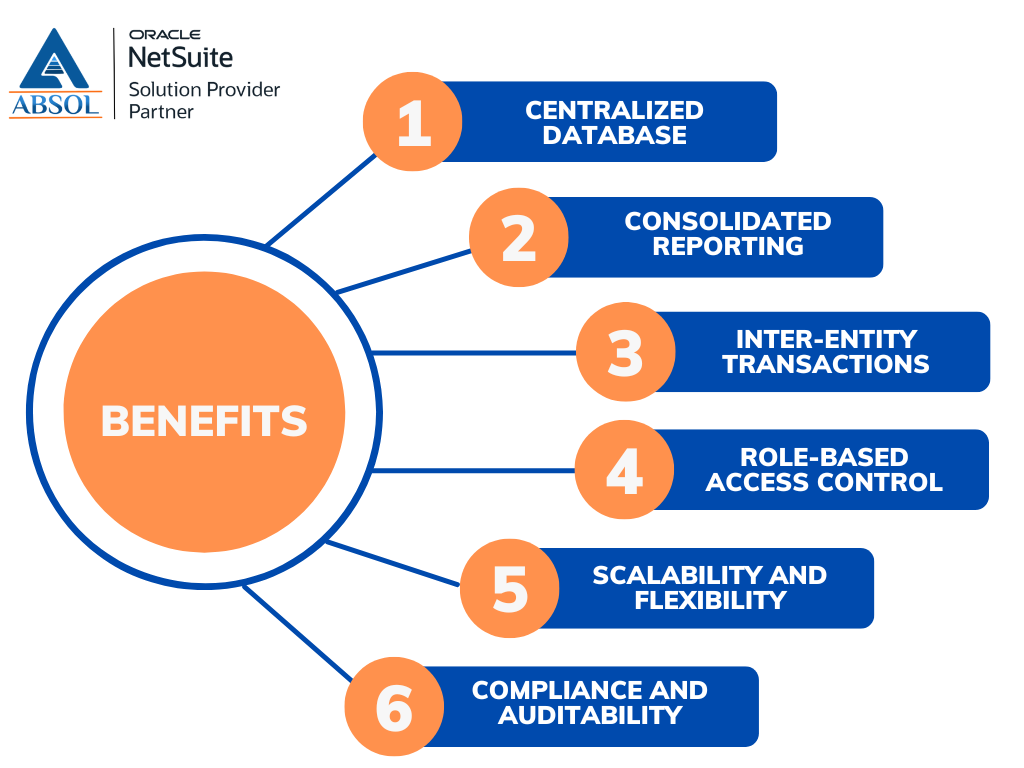
NetSuite offers a range of features and benefits that make it an ideal solution for organizations with multiple entities. These advantages contribute to improved efficiency, accuracy, and compliance in financial management:

  • Centralized Database: NetSuite’s centralized database provides a single source of truth for financial information across all entities. This unified approach eliminates the need for manual data entry, reducing the risk of errors and ensuring consistency in data reporting. With all financial data housed within a single platform, businesses can easily access and analyze information, enabling more efficient decision-making. The centralized database also supports real-time data synchronization, ensuring that financial information is always up-to-date and accurate. This centralized approach not only enhances data accuracy but also reduces the time and effort required to manage financial operations across multiple entities.
  • Consolidated Reporting: NetSuite automates the consolidation process, allowing organizations to generate accurate and comprehensive consolidated financial statements. This automation not only saves time but also reduces the likelihood of errors that can occur with manual consolidations. Companies can easily produce reports that comply with different accounting standards, such as GAAP, IFRS, or local standards, providing a clear overview of the overall financial health of the business. Consolidated reporting capabilities are essential for organizations that need to present financial results to stakeholders across different regions. The ability to generate consolidated reports in real-time enhances the organization’s ability to respond quickly to changes in the business environment.
  • Inter-Entity Transactions: NetSuite simplifies the management of inter-entity transactions, including currency conversions, tax calculations, and intercompany pricing. By automating these processes, NetSuite ensures accurate and timely reporting, reducing the administrative burden on finance teams. This feature is particularly beneficial for businesses that frequently engage in intercompany transactions, as it streamlines the process and minimizes the risk of discrepancies. Efficient management of inter-entity transactions is critical for maintaining financial integrity and avoiding issues related to currency fluctuations and tax obligations. The automation of inter-entity transactions also improves the speed and accuracy of financial reporting, enabling organizations to close their books faster and with greater confidence.
  • Role-Based Access Control: Security is a major concern when managing financial data across multiple entities. NetSuite’s role-based access control enables organizations to grant appropriate permissions to different users, ensuring data security and privacy. This allows businesses to restrict access to sensitive information, providing only the necessary level of access to each user based on their role within the organization. By implementing robust access controls, businesses can protect financial data from unauthorized access and potential security breaches. In addition to enhancing security, role-based access controls also support compliance with data protection regulations, ensuring that the organization meets its legal obligations regarding data privacy and security.
  • Scalability and Flexibility: NetSuite’s scalability and flexibility make it a cost-effective investment for organizations managing multiple entities. The platform is designed to grow with the business, accommodating the addition of new entities, regions, or business units without the need for significant system changes. A recent study found that 84% of ERP users had an expected ERP spend of less than 2% of annual income, indicating that NetSuite’s cost-effectiveness aligns with the broader trend of ERP systems being a valuable investment. This scalability ensures that NetSuite can support the organization’s growth and expansion strategies, providing a future-proof solution for multi-entity management. The flexibility of the platform also allows organizations to customize their ERP system to meet their specific needs, ensuring that NetSuite remains aligned with the business’s objectives and operational requirements.
  • Compliance and Auditability: Meeting regulatory requirements is a critical aspect of multi-entity management. NetSuite helps organizations comply with various regulations by providing features such as audit trails, data retention policies, and support for multiple accounting standards. This not only simplifies compliance but also enhances the auditability of financial data, making it easier for companies to demonstrate adherence to regulatory requirements.

NetSuite also streamlines operations and ensures compliance with regulatory requirements. A recent study found that 80% of businesses have witnessed an increase in efficiency in compliance-related processes after integrating ERP systems. NetSuite’s built-in tax, compliance, and audit features, combined with its ability to standardize operations across entities, make it a valuable tool for managing multiple entities effectively. The platform’s compliance features also support the organization’s efforts to maintain good standing with regulatory authorities, reducing the risk of fines, penalties, and reputational damage.

Conclusion

NetSuite offers a powerful and efficient solution for organizations with multiple entities. By providing a centralized database, automated consolidation, streamlined inter-entity transactions, robust security, and scalability, NetSuite helps businesses achieve greater efficiency, accuracy, and compliance. The platform’s ability to centralize financial operations, automate routine tasks, and support global compliance makes it an invaluable tool for organizations managing multiple entities. By leveraging NetSuite’s capabilities, businesses can overcome the challenges of multi-entity management and unlock new opportunities for growth and success. If your organization is grappling with the complexities of managing multiple entities, exploring NetSuite as a potential solution could be the key to achieving streamlined operations, enhanced financial accuracy, and better business outcomes.

Are you ready to transform your multi-entity management processes and unlock new efficiencies? Discover how NetSuite can streamline your financial operations, enhance compliance, and support scalable growth across your organization. Contact ABSOL today for a personalized demo and see how NetSuite’s powerful features can address the unique challenges of managing multiple entities. Don’t let the complexities of multi-entity management hold your business back—take the next step towards optimized financial management with NetSuite.

Multi-Entity Management with Oracle NetSuite ERP

Multi-Entity Management with Oracle NetSuite ERP

Multi-Entity Management with Oracle NetSuite ERP

Multi-Entity Management with Oracle NetSuite ERP

In today’s business world, where everything is interlinked across the globe, multi-entity management has become most complex and challenging. Companies operating across multiple regions with subsidiaries, branches, or divisions face a myriad of difficulties in maintaining financial reporting accuracy, regulatory compliance, and operational consistency. These challenges are exacerbated by the diverse legal, financial, and operational frameworks that each entity may operate under. Integrated ERP solutions, such as NetSuite, offer a robust solution to these challenges, streamlining the management of multiple entities and significantly improving process efficiency. According to a Gartner report, businesses that have implemented integrated ERP solutions like NetSuite have experienced a 30% improvement in process efficiency. This significant boost in efficiency is one of many benefits NetSuite provides for multi-entity management. This blog will explore the key advantages of using NetSuite to manage multiple entities, with a focus on how it enhances efficiency, compliance, and scalability.

Understanding Multi-Entity Management

Multi-entity management refers to the effective oversight and coordination of various business entities within an organization. These entities might include subsidiaries, joint ventures, branches, or divisions, each operating under distinct legal, financial, and operational frameworks. The challenges associated with managing multiple entities are complex and can significantly hinder business performance if not addressed effectively. Some of the key challenges include:

  • Data Consolidation: Consolidating financial data from various entities into a unified view is a primary challenge in multi-entity management. This process involves gathering data from disparate systems and formats, which can be time-consuming and prone to errors. Ensuring data accuracy in this consolidation process is crucial for generating reliable financial reports and insights that drive strategic decision-making.
  • Compliance: Adhering to different accounting standards, tax regulations, and legal requirements across multiple jurisdictions adds another layer of complexity. Organizations operating in multiple countries must navigate varying regulatory environments, making compliance a challenging and resource-intensive task. Failure to meet these compliance requirements can lead to significant financial penalties and reputational damage.
  • Inter-Entity Transactions: Managing transactions between entities, such as intercompany sales, loans, and expense allocations, presents significant challenges, particularly when different currencies and exchange rates are involved. Accurate recording of these transactions is essential to avoid discrepancies in financial reporting, which could lead to errors in consolidated financial statements and misinformed business decisions.
  • Visibility: Achieving comprehensive visibility into the financial performance of an organization is critical for informed decision-making. However, when financial data is siloed within individual entities, gaining a holistic view of the organization’s financial health becomes challenging. Lack of visibility can lead to inefficiencies, delayed decisions, and missed opportunities.

NetSuite’s Multi-Entity Management Solution

NetSuite provides an advanced multi-entity management solution designed to address the complexities associated with managing multiple entities. This solution enables businesses to operate a centralized financial system that supports the unique needs of each entity while maintaining control and visibility at the group level. The following are some key features of NetSuite’s multi-entity management solution:

  • Centralized Chart of Accounts: NetSuite allows businesses to maintain a centralized chart of accounts that can be applied across all entities. This feature ensures consistency in financial reporting and simplifies the consolidation process. By offering the flexibility to set up shared or unique accounts for each entity, NetSuite accommodates the diverse financial operations of global organizations, allowing for a more streamlined and efficient financial management process.
  • Automated Intercompany Eliminations: NetSuite automates the elimination of intercompany transactions during the consolidation process. This automation is crucial for generating accurate consolidated financial statements, as it reduces the manual workload and minimizes the risk of errors. Automated intercompany eliminations ensure that consolidated reports accurately reflect the organization’s financial performance, free from the distortions caused by intercompany transactions. This feature is particularly beneficial for organizations with frequent inter-entity transactions, as it simplifies and accelerates the consolidation process.
  • Global Compliance and Tax Management: NetSuite supports multiple currencies, tax regimes, and accounting standards, making it easier for global businesses to comply with local regulations. The system handles different tax rates, VAT, GST, and other regional requirements, helping businesses meet their compliance needs across various jurisdictions. This global compliance capability is essential for organizations operating in multiple countries, as it reduces the burden of managing diverse regulatory environments. Moreover, the ability to automatically generate tax reports and manage compliance processes reduces the risk of non-compliance and associated penalties.
  • Multi-Currency Support: NetSuite’s robust multi-currency functionality allows businesses to manage transactions in different currencies seamlessly. The system automatically handles currency conversions, revaluations, and consolidations, ensuring that financial statements accurately reflect currency fluctuations. This feature is particularly beneficial for companies with international operations, as it simplifies the management of cross-border transactions and enhances the accuracy of financial reporting. The ability to operate in multiple currencies without manual intervention also supports business expansion into new markets, providing a competitive advantage.
  • Consolidated Financial Reporting: NetSuite’s multi-entity management solution includes powerful reporting capabilities that allow organizations to generate consolidated financial reports at any time. Businesses can view consolidated results in real-time, drill down into specific entity performance, and produce reports that meet the needs of various stakeholders, such as management, investors, and regulatory bodies. This real-time reporting capability enhances decision-making by providing timely and accurate financial insights. The ability to generate reports that comply with various accounting standards, such as GAAP, IFRS, or local standards, ensures that organizations can meet the diverse reporting requirements of their stakeholders.
  • Customizable Entity Structures: NetSuite supports a wide range of entity structures, from simple to complex, enabling businesses to manage hierarchies that include subsidiaries, branches, and other organizational units. Users can customize these structures to match their specific operational needs, ensuring that the ERP system aligns with the company’s business model. This flexibility in entity structure management allows organizations to adapt to changing business environments and growth strategies. The ability to customize entity structures also supports the integration of new acquisitions or business units, facilitating seamless business expansion.
  • Role-Based Access and Security: To maintain control over financial data, NetSuite provides role-based access controls that allow businesses to define user permissions based on their roles within the organization. This ensures that sensitive information is accessible only to authorized personnel, enhancing data security and compliance. Role-based access controls are particularly important in multi-entity environments, where different users may require different levels of access to financial information. By implementing robust access controls, businesses can protect financial data from unauthorized access and potential security breaches, ensuring that sensitive information remains secure.

Key Advantages of NetSuite for Multi-Entity Management

NetSuite offers a range of features and benefits that make it an ideal solution for organizations with multiple entities. These advantages contribute to improved efficiency, accuracy, and compliance in financial management:

  • Centralized Database: NetSuite’s centralized database provides a single source of truth for financial information across all entities. This unified approach eliminates the need for manual data entry, reducing the risk of errors and ensuring consistency in data reporting. With all financial data housed within a single platform, businesses can easily access and analyze information, enabling more efficient decision-making. The centralized database also supports real-time data synchronization, ensuring that financial information is always up-to-date and accurate. This centralized approach not only enhances data accuracy but also reduces the time and effort required to manage financial operations across multiple entities.
  • Consolidated Reporting: NetSuite automates the consolidation process, allowing organizations to generate accurate and comprehensive consolidated financial statements. This automation not only saves time but also reduces the likelihood of errors that can occur with manual consolidations. Companies can easily produce reports that comply with different accounting standards, such as GAAP, IFRS, or local standards, providing a clear overview of the overall financial health of the business. Consolidated reporting capabilities are essential for organizations that need to present financial results to stakeholders across different regions. The ability to generate consolidated reports in real-time enhances the organization’s ability to respond quickly to changes in the business environment.
  • Inter-Entity Transactions: NetSuite simplifies the management of inter-entity transactions, including currency conversions, tax calculations, and intercompany pricing. By automating these processes, NetSuite ensures accurate and timely reporting, reducing the administrative burden on finance teams. This feature is particularly beneficial for businesses that frequently engage in intercompany transactions, as it streamlines the process and minimizes the risk of discrepancies. Efficient management of inter-entity transactions is critical for maintaining financial integrity and avoiding issues related to currency fluctuations and tax obligations. The automation of inter-entity transactions also improves the speed and accuracy of financial reporting, enabling organizations to close their books faster and with greater confidence.
  • Role-Based Access Control: Security is a major concern when managing financial data across multiple entities. NetSuite’s role-based access control enables organizations to grant appropriate permissions to different users, ensuring data security and privacy. This allows businesses to restrict access to sensitive information, providing only the necessary level of access to each user based on their role within the organization. By implementing robust access controls, businesses can protect financial data from unauthorized access and potential security breaches. In addition to enhancing security, role-based access controls also support compliance with data protection regulations, ensuring that the organization meets its legal obligations regarding data privacy and security.
  • Scalability and Flexibility: NetSuite’s scalability and flexibility make it a cost-effective investment for organizations managing multiple entities. The platform is designed to grow with the business, accommodating the addition of new entities, regions, or business units without the need for significant system changes. A recent study found that 84% of ERP users had an expected ERP spend of less than 2% of annual income, indicating that NetSuite’s cost-effectiveness aligns with the broader trend of ERP systems being a valuable investment. This scalability ensures that NetSuite can support the organization’s growth and expansion strategies, providing a future-proof solution for multi-entity management. The flexibility of the platform also allows organizations to customize their ERP system to meet their specific needs, ensuring that NetSuite remains aligned with the business’s objectives and operational requirements.
  • Compliance and Auditability: Meeting regulatory requirements is a critical aspect of multi-entity management. NetSuite helps organizations comply with various regulations by providing features such as audit trails, data retention policies, and support for multiple accounting standards. This not only simplifies compliance but also enhances the auditability of financial data, making it easier for companies to demonstrate adherence to regulatory requirements.

NetSuite also streamlines operations and ensures compliance with regulatory requirements. A recent study found that 80% of businesses have witnessed an increase in efficiency in compliance-related processes after integrating ERP systems. NetSuite’s built-in tax, compliance, and audit features, combined with its ability to standardize operations across entities, make it a valuable tool for managing multiple entities effectively. The platform’s compliance features also support the organization’s efforts to maintain good standing with regulatory authorities, reducing the risk of fines, penalties, and reputational damage.

Conclusion

NetSuite offers a powerful and efficient solution for organizations with multiple entities. By providing a centralized database, automated consolidation, streamlined inter-entity transactions, robust security, and scalability, NetSuite helps businesses achieve greater efficiency, accuracy, and compliance. The platform’s ability to centralize financial operations, automate routine tasks, and support global compliance makes it an invaluable tool for organizations managing multiple entities. By leveraging NetSuite’s capabilities, businesses can overcome the challenges of multi-entity management and unlock new opportunities for growth and success. If your organization is grappling with the complexities of managing multiple entities, exploring NetSuite as a potential solution could be the key to achieving streamlined operations, enhanced financial accuracy, and better business outcomes.

Are you ready to transform your multi-entity management processes and unlock new efficiencies? Discover how NetSuite can streamline your financial operations, enhance compliance, and support scalable growth across your organization. Contact ABSOL today for a personalized demo and see how NetSuite’s powerful features can address the unique challenges of managing multiple entities. Don’t let the complexities of multi-entity management hold your business back—take the next step towards optimized financial management with NetSuite.

NetSuite ERP_ Driving Sustainability Across Your Business

NetSuite ERP: Driving Sustainability Across Your Business

NetSuite ERP: Driving Sustainability Across Your Business

In today’s world, sustainability isn’t a fad – it’s a fundamental business imperative. Consumers, with 83% prioritizing companies that address social and environmental issues, are driving this change. Investors are increasingly favoring sustainable practices, and regulations are evolving to emphasize environmental and social responsibility. Businesses that prioritize sustainability not only contribute to a healthier planet but also unlock a wealth of opportunities – from attracting and retaining talent to securing funding and boosting brand loyalty. But how do you navigate this shift and become a sustainability leader?

NetSuite ERP: Empowering Sustainable Transformation

NetSuite ERP goes beyond traditional enterprise resource planning, offering a comprehensive platform to propel your sustainability journey. This powerful solution equips you with features and functionalities designed to minimize environmental impact, champion social responsibility, and drive economic prosperity. Here’s how:

Reduce Your Environmental Impact

  • Cut Carbon Footprint:study found that businesses implementing paperless practices can cut their carbon footprint by up to 35%. Embrace features like document management and electronic approvals in NetSuite, a true cloud ERP, to significantly cut down on paper usage.
  • Streamlined Processes: NetSuite streamlines processes, eliminates unnecessary steps, and provides real-time data on energy consumption across departments. This empowers you to identify areas for improvement and implement targeted strategies to reduce energy waste. For example, a Harvard Business Review study suggests that companies can achieve up to a 30% reduction in energy consumption by implementing data-driven energy management practices.
  •  Minimize Waste:  The Environmental Protection Agency (EPA) estimates that businesses generate over 12 million tons of food waste annually.  NetSuite can help you identify areas for waste reduction and improve your environmental impact. NetSuite helps you track and manage waste disposal more effectively, leading to reduced waste generation and increased recycling rates.

Champion Social Responsibility

Choosing the right ERP system is like building your business headquarters. Do you go for a self-standing fortress (on-premise) or a modern, connected high-rise (cloud)? This section dives into the deployment models of NetSuite and Dynamics, security considerations, and how they integrate with your existing systems.

  • Ethical Labor Practices: Ensure wage equity, safe working conditions, and compliance with labor regulations through efficient employee data tracking and management within NetSuite ERP.  A study by Cone Communications revealed that 78% of employees would be more likely to work for a socially responsible company.
  • Enhance Employee Well-being: Promote work-life balance with features like flexible scheduling and remote work capabilities. Happy and healthy employees are more engaged and productive, leading to a positive impact on your business. A MeQuilibrium study showed that companies with strong well-being programs experience a 21% increase in profitability.
  • Supporting Ethical Sourcing: Trace the origin of products and resources with ease, ensuring ethical trade practices throughout your supply chain. This builds trust with customers who increasingly prioritize responsible sourcing. A Nielsen report highlights that 66% of global consumers are willing to pay more for sustainable products.

Drive Economic Benefits through Sustainability

  • Boost Profitability: Save costs through efficient resource management, reduced waste generation, and optimized inventory control. An Aberdeen Group study found that companies with best-in-class inventory management practices experience 43% lower carrying costs.
  • Build Brand Loyalty: Consumers are increasingly drawn to brands with strong sustainability commitments. By integrating sustainability into your business practices and showcasing them through NetSuite’s reporting capabilities, you can build brand loyalty and attract new customers who share your values.
  • Ensure Long-Term Growth: NetSuite ERP equips you with the tools to adapt to evolving sustainability trends, regulations, and customer preferences. This empowers you to stay ahead of the curve and ensure long-term growth for your business.

Conclusion

NetSuite provides real-time data and comprehensive insights so you can make informed decisions about your sustainability journey. This empowers you to:

  • Monitor environmental impact effectively.
  • Prioritize sustainable strategies with confidence.
  • Make significant progress towards sustainability goals with a platform that goes beyond traditional ERP.

NetSuite is your partner in creating a more sustainable future.  Contact us today to learn how NetSuite ERP can help your business thrive.

Finding the Right ERP_ An Ultimate ERP Selection Guide

Finding the Right ERP: An Ultimate ERP Selection Guide

Finding the Right ERP: An Ultimate ERP Selection Guide

Finding the Right ERP_ An Ultimate ERP Selection Guide

Imagine you run an assembling organization that produces bikes. Your business includes different divisions, like creation, stock administration, deals, money, and client assistance. Every division has its own arrangement of cycles and information, which are right now overseen utilizing separate situation or accounting sheets. By implementing an ERP system, a large amount of data and processes can be integrated into a single platform.

Enterprise Resource Planning (ERP) software is designed to help companies integrate and manage their essential processes and data in a centralized system. Enhancing business operations involves technical tools and management practices to improve performance and growth. The ERP system acts as a central hub that connects and coordinates all the different functions of the business. It streamlines operations, improves visibility and control, and enables better decision-making across the organization. But how do you choose the right one?

Having the right tools and resources plays a crucial role in maintaining the health and success of a business in today’s world. An important tool that can greatly impact a business’s functionality and overall performance is the Enterprise Resource Planning (ERP) system. This guide aims to provide insights and suggestions to help you choose the right ERP system for pour business through a set of tips.

Benefits of Using ERP Software:

A study by Panorama Consulting Group found that ERP implementations can lead to a 23% reduction in operational costs. By putting resources into the right ERP programming, organizations can acquire a huge upper hand through expanded productivity, cost investment funds, and further developed dynamic capacities.

  • Increased efficiency and productivity: ERP software integrates business processes, eliminates manual data entry, reduces errors, and enhances efficiency.
  • Improved data accuracy and consistency: ERPs centralize data from all departments, eliminating silos and manual entry. This ensures consistency, reducing discrepancies and providing reliable information. It enables informed decisions, contributing to the organization’s success.
  • Enhanced collaboration and communication: ERP software streamlines collaboration by providing a centralized platform for real-time data access and integrated communication tools. This fosters better teamwork, faster decision-making, and increased innovation within the organization.
  • Better visibility into business processes: ERP systems offer reporting and analytics capabilities that provide insights into various aspects of the business. They generate customizable reports and dashboards, enabling organizations to monitor KPIs, identify trends, and track progress towards goals. This empowers decision-makers to make data-driven decisions for business growth.
  • Cost savings through automation and optimization: ERP software automates tasks, optimizes processes, reduces errors, and eliminates inefficiencies. This leads to cost savings, minimized overheads, better resource utilization, and improved inventory management, procurement, and supply chain optimization.

Popular ERP Features:

In managing different aspects of a business, certain ERP features or ERP modules are present across various Enterprise Resource Planning (ERP) software platforms.

  • Financial Management: Choosing the right ERP system can lead to significant long-term financial benefits. This component streamlines financial processes such as bookkeeping, planning, invoicing, and reporting. It provides a comprehensive view of the organization’s financial health by managing accounts payable, accounts receivable, and financial analysis.    
  • Inventory Management: Effective stock administration is essential for organizations to improve stock levels, limit costs, and guarantee ideal request satisfaction. ERP programming has stock administration includes that track stock, renewing stock, conjecturing interest, and overseeing distribution centres. By bringing together stock information and computerizing processes, organizations can further develop precision and smooth out store network tasks.
  • Human Resource Management: The HR module in ERP programming smoothes out the labor force the board. It incorporates representative data, finance, benefits, participation following, execution, and ability obtaining. This guarantees consistency and lifts commitment. HR divisions can work all the more productively with this module.
  • Customer relationship management: Customer Relationship Management (CRM) is a vital component of Enterprise Resource Planning (ERP) systems. It offers sales automation, lead management, customer support, marketing campaigns, and customer analysis. By consolidating customer data and providing insights into customer behavior, ERP-based CRM solutions help businesses to establish stronger customer relationships and boost sales growth. 
  • Reporting and analytics: Enterprise Resource Planning (ERP) software enables companies to generate standard and customized reports on different aspects of their operations such as financial performance, inventory levels, sales statistics, and HR analysis. The analysis tools within ERP systems employ advanced algorithms and data visualization techniques to identify trends, patterns, and growth opportunities. 
  • Project Management: Tools for organizing, scheduling, and tracking activities and tasks are essential for efficiency and productivity. These tools often include features such as resource allocation, progress tracking, and task collaboration to help individuals and teams manage their workloads more effectively.
  • Manufacturing Resource Planning: The software is useful for planning creation exercises, managing bills of materials (BOM), work orders, and controlling the shop floor.

Identifying Your Business Needs

Before selecting an ERP system, it is important to assess your current processes, define your goals, and consider flexibility and integration.

Evaluating Your Current Processes

It is crucial to evaluate your current work processes and identify any areas that need improvement or are problematic. This will help you determine the essential features and functionalities that are necessary for your business. Assessing your current situation is important because your existing business processes will serve as the foundation for any ERP implementation.

Defining Your Goals and Objectives

As an entrepreneur, it is crucial to have a clear understanding of your goals and objectives before selecting an ERP system. The ERP software should align with your primary vision and help you achieve your business goals and objectives. Whether you intend to improve customer satisfaction, increase productivity, or expand into new markets, ensure that the ERP system has the necessary features and functionalities to support your vision. By defining your business goals and objectives, you can ensure that the ERP system you choose will help you achieve your desired outcomes.

Considering Scalability and ERP Integration

It is crucial to choose an ERP solution that can grow with your business and seamlessly integrate with other applications or systems you already use. This will be essential to accommodate future growth and changing business needs. A scalable ERP system will enable your business to expand its operations without requiring a complete upgrade of the software, thereby reducing the costs and time involved in the implementation process. Additionally, integration with other systems such as CRM, E-commerce, and productivity tools will provide a comprehensive overview of your business operations and improve efficiency. Therefore, when selecting ERP system, make sure to consider scalability and integration as important factors in your decision-making process.

Researching and Comparing ERP Solutions

It is important to explore and evaluate different Business ERP solutions to find the best fit for your business.

Exploring Different Types of ERP Systems

Choosing the appropriate type of Enterprise Resource Planning (ERP) system is crucial for businesses as it impacts their efficiency, flexibility, and overall performance. There are various types of ERP systems available, such as cloud-based, on-premise, or hybrid solutions, and each type has its own set of advantages and disadvantages. Here are some factors to consider when evaluating each type of ERP system.

  • Cost: Cloud-based ERP systems generally have lower initial costs as they don’t require any hardware investments or IT staff to manage the system. On the other hand, on-premise ERP systems require significant upfront investments in hardware and IT staff. Hybrid solutions offer a balance between the two, allowing companies to keep critical data on-premise while utilizing cloud-based resources for non-critical functions.
  • Customisation options: Cloud-based ERP systems typically have limited customization options as they are designed to be more standardized and flexible. On-premise ERP systems provide more customization options since they are installed on the company’s own servers. Hybrid solutions provide a balance between the two, allowing businesses to customize essential features while using standardized cloud-based resources for non-essential features.
  • Deployment flexibility: Cloud-based ERP systems provide greater flexibility in terms of access as they can be accessed from anywhere with an internet connection. On-premise ERP systems require employees to be physically present to access the system. Hybrid solutions offer a balance between the two, allowing companies to access critical data on-premise while using cloud-based resources for non-critical functions.

By ERP evaluation each type of ERP system based on these factors and considering the specific requirements of their business, companies can choose the best fit for their organization.

After considering these factors and evaluating each type of ERP system based on their specific business requirements, companies can choose the most suitable option for their organization.

Steps to choosing the Right ERP:

1. Reviewing User Reviews and Ratings

It is important to examine client reviews and ratings to gain insights into their ERP experience. Popular online survey platforms for ERP software include G2, Capterra, and TrustRadius.

On these platforms, you can access surveys and evaluations shared by real customers who have utilized various ERP systems. It is important to pay attention to feedback related to customer service, system usability, and overall satisfaction

2. Requesting Demos and Trials

If you’re looking to gain a better understanding of ERP software, it’s recommended that you request demos and trials from your shortlisted vendors to experience the software firsthand. By doing this, you’ll be able to evaluate its user interface, features, and functionalities and make a well-informed decision.

3. Creating a Shortlist of Potential ERP Vendors

Based on your analysis and evaluations, create a list of potential ERP vendors that align with your business requirements. Take into account factors such as product capabilities, pricing, customer support, and vendor reputation. It will recommend the following potential ERP vendors that can meet your needs. Some of the prominent vendors include NetSuite, Microsoft Dynamics 365, SAP, Epicor, Infor CloudSuite, and Acumatica. Evaluate each vendor based on their product capabilities, pricing, customer service, and reputation before making a final decision.

4. Comparing Costs and Licensing Models

When selecting an ERP solution, it is crucial to evaluate the total cost of ownership. This involves comparing the costs and licensing models of the solutions on your shortlist. You need to consider factors such as upfront costs, subscription fees, implementation costs, and ongoing maintenance costs. By doing so, you can make an informed decision and choose the ERP solution that best fits your budget and business requirements.

5.  Consulting with Experts or ERP Consultants

If you are considering implementing an ERP system, it is always wise to seek advice from experts or professionals in the field. They can provide you with valuable insights and recommendations based on their expertise, and help you navigate the complexities of selecting and implementing an ERP system successfully. With their guidance, you can ensure that you make informed decisions that align with your business needs and goals.

Summary

Choosing the right ERP software for your business is a crucial decision that requires thorough assessment, research, and expert guidance. By following the steps outlined in this blog post – understanding the basics of ERP software, identifying your business needs, researching and comparing ERP solutions, making an informed decision, and implementing and optimizing your selected ERP software – you can streamline your business processes, drive growth, and achieve long-term success.

Note:

ABSOL is a trustworthy provider of business technology solutions. We understand that selecting an ERP system can be a daunting task for any business. To assist you in finding the perfect fit for your organization, ABSOL has created a comprehensive guide that will provide you with the necessary knowledge and strategies. Additionally, we offer a range of services, including needs assessments and implementation support, to help businesses navigate the ERP selection process with ease.

Contact ABSOL today for a free consultation. Let our experts recommend the most suitable NetSuite ERP modules for your business needs. Don’t wait – unlock the possibilities of NetSuite ERP modules, and transform your business with confidence.

Choosing the Right ERP_ Unveiling the NetSuite vs. Dynamics Dilemma

Choosing the Right ERP: Unveiling the NetSuite vs. Dynamics Dilemma

Choosing the Right ERP: Unveiling the NetSuite vs. Dynamics Dilemma

Imagine you’re running a thriving business, but your current software operates like a clunky machine, hampering your progress. Spreadsheets are overflowing, data is scattered across unconnected islands, and manual processes slow you down. You know it’s time for a change, but with a vast and complex ERP landscape, choosing the right system feels daunting. Oracle NetSuite and Microsoft Dynamics – both seem powerful, but which one will guide your unique business journey?

This is a common challenge faced by countless companies like yours. Selecting the right ERP system is a critical decision, one that can propel you forward or leave you feeling stagnant. The abundance of online ERP comparisons adds to the confusion, often leaving you with more questions than answers.

But worry not! At ABSOL, we’ve been guiding businesses through this very process for years. We have deep understanding of the ERP industry, and we’re passionate about helping you find the perfect fit, not just another generic ERP comparison.

In this blog, we’ll go beyond surface-level features and technical jargon. We’ll focus on real-world scenarios, industry-specific needs, and most importantly, the practical solutions each system offers. Whether you’re a manufacturer grappling with inventory complexities or a service-based business yearning for seamless automation, we’ll help you understand how Oracle NetSuite or Dynamics can address your specific challenges and fuel your growth.

Consider this blog your roadmap to navigating the ERP selection process with clarity and confidence. Join us as we explore:

  • The hidden costs of outdated systems: We’ll uncover the true impact of inefficient software on your business, beyond just the initial price tag.
  • Demystifying the NetSuite vs. Dynamics landscape: We’ll compare core functionalities, deployment models, and industry-specific strengths, all presented in an easy-to-understand format.
  • Implementation insights: We’ll shed light on the process, highlighting our expertise in guiding you through a smooth transition.
  • The TCO equation: We’ll go beyond upfront costs and delve into the total cost of ownership, helping you make a financially sound decision.

Remember: choosing the right ERP system is about more than just ticking features off a list. It’s about selecting a partner that aligns with your vision and empowers your unique journey. Let us be your trusted guide on this crucial decision. Stay tuned as we embark on this informative exploration, together!

Unveiling the Architecture Cloud vs. On-Premise, Security & Integration

Choosing the right ERP system is like building your business headquarters. Do you go for a self-standing fortress (on-premise) or a modern, connected high-rise (cloud)? This section dives into the deployment models of NetSuite and Dynamics, security considerations, and how they integrate with your existing systems.

  • Deployment Showdown: Cloud vs. On-Premise: NetSuite is exclusively cloud-based, meaning your data and applications reside in secure data centers managed by Oracle. This translates to easy accessibility from anywhere, automatic updates, and minimal IT maintenance. Think of it as a fully managed high-rise with 24/7 security and IT support.Dynamics offers more flexibility, with on-premise, cloud, and hybrid options. You can host the system yourself, partner with a managed service provider, or choose a combination. It’s like customizing your office building – flexibility comes with responsibility, as you manage hardware, software updates, and security.
  • Security and Scalability: Cloud security concerns are understandable. NetSuite addresses these with a robust multi-tenant cloud architecture and industry-leading security certifications. Imagine multiple businesses operating securely within a high-rise, each with their own dedicated space and access controls. Scalability is seamless – as your business grows, your “cloud office” expands automatically.Dynamics on-premise deployments require your own security measures, while cloud and hybrid options offer varying levels of managed security. Scalability with on-premise requires additional hardware and IT expertise, while cloud options scale elastically.
  • Integration Flexibility: Connecting your ERP to existing systems is crucial for streamlined operations. NetSuite boasts an open API and a vast library of pre-built integrations. Think of it as having various docking ports in your high-rise for easy connection to external services. While Dynamics offers native integrations, some specific connections might require customization, like building custom bridges between your high-rise and other buildings.

Remember: The best deployment model depends on your specific needs and IT expertise. We’ll explore each option in greater detail in future sections, helping you choose the right “building” for your business.

Feature Face-Off – From Core Functionalities to Industry-Specific Solutions

Now that we’ve explored the building blocks (deployment models and security), let’s delve into the features that make each “ERP office” function. We’ll compare core functionalities, industry-specific solutions, and mobile access & automation capabilities.

Core Functionalities: A Head-to-Head Match:

Imagine your ERP as the central hub managing your business operations. Both NetSuite and Dynamics offer robust core functionalities like:

  • Financials: Streamline accounting, manage cash flow, and gain real-time financial insights.
  • Inventory Management: Optimize inventory levels, track stock movement, and improve
    forecasting.
  • Project Management: Plan, track, and collaborate on projects effectively.
  • Reporting & Analytics: Generate insightful reports and gain valuable business intelligence.

But how do they compare in real-world scenarios? Consider a manufacturing company:

NetSuite: Its built-in features for production planning and shop floor control help optimize production processes.

Dynamics: Its customization capabilities allow for tailoring the system to specific manufacturing needs, like complex bill of materials management.

 Industry-Specific Solutions: Pre-Built vs. Custom Fit:

NetSuite shines with its pre-built industry solutions for various sectors like healthcare, non-profit, and professional services. These offer pre-configured features and workflows tailored to specific industry needs. Imagine having a pre-designed office layout for your industry, saving time and resources.

Dynamics, on the other hand, focuses on a highly customizable approach. You can tailor the system to your unique industry requirements, but this might require more development effort. Think of it as building your office from scratch, offering maximum flexibility but requiring more planning and expertise.

Mobile Access & Automation: Working Smarter, Not Harder:

In today’s mobile-first world, accessing your ERP on the go is crucial. Both NetSuite and Dynamics offer mobile apps for key functionalities, allowing you to stay connected and productive anywhere.

NetSuite boasts a wider range of pre-built automation features, like automated purchase orders and invoice approvals. Dynamics, however, offers more flexibility in customizing automation workflows.

Imagine automating repetitive tasks in your office – NetSuite provides pre-built robots, while Dynamics allows you to build your own customized robots.

Remember: The best “features” depend on your specific needs and industry. We’ll explore each area in more detail in future sections, and you can always consult with ABSOL experts to find the perfect fit for your business.

ERP CustomizationTailoring Your ERP Fit:

So far, we’ve explored the building blocks, features, and industry focus of each contender. But what about making them truly your own? This section dives into customization, and the true cost of ownership (TCO).

  • ERP customization: Imagine your dream office – perfectly designed for your unique workflow. Customization in ERP allows you to achieve this, but like any renovation, it comes with considerations. While NetSuite offers a robust foundation, its SuiteCloud development platform empowers deeper customization (NetSuite vs. Dynamics, ERP customization). Think of it as having access to skilled architects and builders to modify your office space. Dynamics, on the other hand, leans towards flexibility through configuration. Consider it like adjusting furniture and layouts within a pre-built structure.The key is finding the right balance. Extensive customization can be costly and time-consuming, potentially hindering future upgrades. ABSOL’s expertise lies in understanding your needs and recommending the optimal level of customization for a long-term, sustainable solution. We partner with both NetSuite and Dynamics, acting as your trusted architects during the entire process.
  • Total Cost of Ownership (TCO): Looking Beyond the Price Tag: Don’t be fooled by upfront costs alone. TCO factors like licensing fees, maintenance, scalability, and user training play a crucial role in the long-term financial picture. While NetSuite’s cloud-based model offers predictable subscription costs, its customization options can impact TCO (Total Cost of Ownership). Dynamics, with its on-premise and hybrid options, may have lower upfront costs but requires additional IT infrastructure and expertise, potentially increasing TCO over time.

Beyond the ERP Comparison Your Personalized Path to ERP Success:

So, who wins the ERP battle royale – NetSuite or Dynamics? The truth is, there’s no single champion. The “best” ERP system depends entirely on your unique business needs and goals.

Remember, you’re not choosing a winner; you’re choosing the perfect partner for your growth journey.

Here’s a quick recap of the key differences we’ve explored:

  • Deployment: NetSuite shines in the cloud, while Dynamics offers flexibility with on-premise, cloud, and hybrid options.
  • Features: Both offer robust core functionalities, but NetSuite boasts pre-built industry solutions, while Dynamics excels in customization.
  • Customization: NetSuite’s SuiteCloud platform empowers deeper customization, while Dynamics leans towards configuration flexibility.
  • Implementation: ABSOL’s proven methodology ensures a smooth transition for both options.
  • TCO: Consider hidden costs like scalability and user training beyond upfront pricing.

Schedule a free consultation with us today! Let’s have an open conversation, assess your specific requirements, and recommend the optimal solution to empower your growth. Remember, choosing the right ERP is a collaborative journey, and we’re here to guide you every step of the way.

Sources: