

5 Reasons Oracle NetSuite Revenue Recognition is a Game Changes

5 Reasons Oracle NetSuite Revenue Recognition is a Game Changer

5 Reasons Oracle NetSuite Revenue Recognition is a Game Changer

Efficient and accurate revenue recognition is the backbone of any successful business. With the ever-growing complexity in accounting standards, diverse revenue models, and the need for automation, manual revenue processes are increasingly prone to errors and inefficiencies. Managing revenue recognition manually is not only time-consuming but also carries the risk of non-compliance with regulatory frameworks.

Enter Oracle NetSuite Revenue Recognition, a powerful solution that revolutionizes how businesses handle revenue operations. With automation, compliance tools, and real-time reporting, Oracle NetSuite is setting new benchmarks for revenue management in businesses of all sizes.

Why Revenue Recognition Matters

The importance of accurate and timely revenue recognition cannot be overstated. Revenue recognition ensures that businesses report their financial performance accurately, providing transparency to investors, stakeholders, and auditors. The introduction of frameworks like ASC 606 and IFRS 15 has made it even more crucial for businesses to automate and streamline revenue recognition. These standards outline how to recognize revenue in a way that reflects the true economic value of business transactions.

However, compliance with these standards is only one part of the equation. To truly thrive in the modern business world, companies must handle revenue processes efficiently and scale seamlessly as they grow. Oracle NetSuite Revenue Recognition not only simplifies compliance but also enhances operational efficiency and decision-making.

Let’s dive into the five compelling reasons why Oracle NetSuite Revenue Recognition is a game changer for businesses of all sizes.

1. Compliance Made Simple with ASC 606 and IFRS 15 Standards

One of the greatest challenges in revenue recognition is ensuring adherence to strict standards like ASC 606 compliance and IFRS 15 standards. These frameworks were designed to create a uniform approach to recognizing revenue from contracts with customers, and they are mandatory for businesses operating in many industries. The standards ensure that revenue is recognized accurately based on specific performance obligations and timelines.

Oracle NetSuite Revenue Recognition takes the complexity out of these regulations. The system automatically ensures that all revenue calculations and allocations comply with ASC 606 and IFRS 15. Whether your business is operating under multi-element arrangements or deals with deferred revenue, NetSuite handles the hard work of ensuring your revenue recognition process is compliant and accurate. This reduces the risk of financial misreporting, audit penalties, and regulatory fines.

NetSuite’s built-in tools can automate revenue calculations across multiple revenue streams, ensuring businesses can focus on scaling and growing rather than worrying about compliance. With audit readiness features, the system allows for quick and easy access to accurate financial records, keeping your business prepared for scrutiny at any time. By automating complex revenue processes, NetSuite ensures financial compliance while reducing the risk of human error.

2. Streamlining Revenue Processes with Automation

Manual revenue processes are not only time-consuming but also prone to errors. When revenue is allocated incorrectly or reported late, it can affect decision-making and cause discrepancies in financial reporting. For businesses managing multiple revenue sources, manually handling revenue recognition is inefficient and unsustainable.

Oracle NetSuite Revenue Recognition helps businesses streamline operations with its revenue automation software, handling everything from revenue allocation to subscription billing. For businesses operating on SaaS models or other subscription-based revenue models, this is especially important. SaaS businesses often need to manage recurring billing cycles and ensure compliance with complex revenue recognition rules. NetSuite’s solution is designed to automate these tasks, ensuring consistent and accurate reporting.

NetSuite’s revenue automation software is not just about simplifying tasks—it also integrates with other financial systems, further improving the accuracy and consistency of data across the business. Whether your company deals with multi-element arrangements, performance obligations, or long-term contracts, NetSuite’s automation ensures that your revenue processes are optimized for operational efficiency.

This level of automation not only speeds up revenue processes but also reduces reliance on manual intervention, thus improving accuracy. Revenue cycle efficiency is significantly enhanced, ensuring businesses can focus on other critical areas like growth and innovation.

3. Enhanced Revenue Forecasting and Real-Time Reporting

For businesses aiming to scale, forecasting is crucial. Understanding future revenue streams enables decision-makers to plan effectively and make informed choices about investments, expansions, and resource allocation. Oracle NetSuite Revenue Recognition provides businesses with the ability to generate accurate, data-driven insights that can inform future growth strategies.

NetSuite’s revenue forecasting capabilities leverage historical data and current trends to predict future revenue. By analyzing this data, decision-makers can gain a clear picture of upcoming revenue streams, allowing them to adjust business strategies accordingly. These insights are particularly valuable for businesses dealing with fluctuating demand, seasonality, or long-term contracts.

Additionally, real-time reporting ensures that businesses always have up-to-date financial data at their fingertips. This real-time access to financial information empowers leaders to make proactive decisions. Whether it’s tracking deferred revenue management, analyzing multi-element arrangements, or managing subscription billing, NetSuite delivers a transparent, accurate financial picture. Real-time visibility into key metrics such as revenue recognition, deferred revenue, and contract performance ensures that businesses remain agile and responsive to changes in the market.

NetSuite’s combination of predictive analytics and real-time reporting makes it an indispensable tool for businesses looking to make data-driven decisions. This enables organizations to focus on scaling while maintaining complete control over financial operations.

4. Comprehensive Management of Complex Revenue Scenarios

Modern businesses often deal with complex revenue scenarios, such as bundled contracts or multi-element arrangements. For example, a company may sell a product bundled with a service subscription or offer long-term contracts with various performance milestones. These scenarios require precise revenue allocation to ensure compliance and accuracy.

Oracle NetSuite’s contract management feature is designed to simplify the process of revenue recognition for businesses dealing with complex revenue arrangements. It automatically allocates revenue across different elements of a contract, ensuring that revenue is recognized correctly based on the specific performance obligations of each element.

For instance, if a business sells a product that is bundled with a service subscription, NetSuite will automatically split the revenue between the product and service components, in line with ASC 606 compliance and IFRS 15 standards. This ensures that businesses remain compliant with regulatory frameworks while accurately recognizing revenue for each part of the contract.

NetSuite’s deferred revenue management capabilities further enhance financial compliance by ensuring that revenue is only recognized once performance obligations are met. This ensures that revenue recognition is aligned with business activity, improving both financial compliance and financial transparency for stakeholders. It also reduces the risk of prematurely recognizing revenue, which could lead to inaccurate financial reporting.

5. Improved Financial Transparency and Audit Readiness

In today’s highly regulated business environment, transparency and accountability are non-negotiable. Businesses must maintain clear records of their financial transactions, and any inconsistencies can have significant repercussions. Oracle NetSuite addresses this need for transparency by offering unparalleled financial clarity and audit readiness.

NetSuite provides detailed records of every revenue transaction, ensuring that every entry is accurate and transparent. Its audit readiness tools simplify the audit process by automatically providing clear documentation and compliance checks. This makes audits faster and more efficient, reducing the preparation time required and minimizing the chances of discrepancies.

NetSuite’s built-in compliance checks ensure that all revenue transactions align with ASC 606 compliance, IFRS 15 standards, and other global regulations. This peace of mind allows businesses to focus on growth and innovation rather than constantly worrying about regulatory issues.

Additionally, NetSuite integrates seamlessly with NetSuite Advanced Financials, enhancing visibility across financial operations. This integration ensures that businesses can maintain compliance and optimize their revenue recognition processes, even as they scale.

How Oracle NetSuite Revenue Recognition Transforms Businesses

Oracle NetSuite Revenue Recognition is designed to tackle the complexities of modern financial management, helping businesses handle multifaceted revenue models and maintain compliance with global accounting standards. Below are key ways it transforms critical aspects of revenue management:

Revenue Cycle Efficiency

Oracle NetSuite automates the entire revenue recognition process, reducing the need for manual intervention and ensuring data accuracy. From identifying performance obligations to recognizing revenue based on milestones, it improves efficiency across the revenue cycle. Businesses save valuable time and resources, enabling their finance teams to focus on strategic tasks rather than routine data entry.

With automation in place, Oracle NetSuite minimizes the risk of human errors that can often arise from manual data entry, such as misclassifying transactions or missing revenue recognition milestones. This ensures greater accuracy in the financial records, which ultimately leads to more reliable financial reporting and better decision-making capabilities.

Revenue Automation Software for Complex Needs

As businesses scale and their revenue models become more complex, traditional manual systems struggle to keep pace. NetSuite’s revenue automation software simplifies intricate operations such as handling multi-element arrangements, managing deferred revenue, and recognizing revenue over time. This ensures compliance with global standards like ASC 606 and IFRS 15, while providing flexibility to adapt to different business models, including SaaS, subscription billing, and long-term contracts.

NetSuite’s flexibility also allows businesses to easily adapt their revenue recognition to changing business models. For example, companies transitioning to subscription-based or usage-based models can continue using NetSuite’s automation tools to allocate and recognize revenue properly. This adaptability ensures that the software remains a vital tool for businesses even as they evolve.

Streamlining Revenue Processes for Scalability

Oracle NetSuite provides businesses with the scalability they need to handle growing revenue streams. Whether managing hundreds of contracts or handling thousands of subscription renewals, the system streamlines revenue processes and ensures consistent accuracy. Its ability to integrate with other modules, like NetSuite Advanced Financials, ensures seamless operations even as businesses expand into new markets or introduce new product lines.

Worldwide public cloud services revenue is expected to increase at a CAGR of 19%, with global revenues forecast to reach $1.3 trillion by 2027. This growth highlights the importance of scalable cloud-based solutions like Oracle NetSuite to manage expanding business needs efficiently.

SaaS Revenue Recognition Tailored for the Subscription Economy

The subscription economy presents unique challenges, such as recurring billing cycles, usage-based pricing, and compliance with regulations like ASC 606. Oracle NetSuite is particularly suited for SaaS businesses, providing tools for precise revenue tracking, automated renewals, and seamless revenue allocation. This ensures not only compliance but also enhanced customer satisfaction through accurate invoicing and billing.

NetSuite’s tailored features also allow businesses to handle increasingly complex subscription models, including hybrid models, where a combination of product sales and service subscriptions is involved. These capabilities ensure that businesses in the subscription economy can recognize revenue efficiently and correctly, even as their offerings become more diverse or personalized.

Real-Time Reporting for Informed Decision-Making

One of the standout features of Oracle NetSuite is its ability to provide real-time reporting. Businesses can access up-to-date financial insights, helping decision-makers evaluate performance and plan for the future with confidence. Real-time visibility into metrics like deferred revenue management, revenue forecasting, and contract performance enables leaders to make proactive and informed decisions.

In addition to real-time reporting, Oracle NetSuite’s predictive analytics capabilities help businesses forecast future revenue streams with greater accuracy. This allows financial teams to anticipate market trends, evaluate potential risks, and develop strategies for mitigating these risks before they become critical issues. This proactive approach to decision-making enhances overall business agility and strengthens the company’s ability to respond to challenges in a timely manner.

Final Thoughts

Oracle NetSuite Revenue Recognition is more than just software—it’s an essential solution for modern businesses navigating the complexities of revenue management. By offering compliance with ASC 606 and IFRS 15 standards, automation, real-time reporting, and enhanced financial transparency, NetSuite streamlines revenue processes, reduces manual work, and empowers businesses to focus on growth and strategic objectives.

The system’s ability to scale with businesses and adapt to a wide range of revenue models ensures that companies remain agile in an ever-changing market environment. By providing tools for accurate revenue tracking, seamless integrations, and comprehensive reporting, Oracle NetSuite enables businesses to make informed decisions that drive growth, improve customer satisfaction, and enhance compliance.

For businesses looking to stay competitive and compliant, adopting Oracle NetSuite Revenue Recognition isn’t just a smart move—it’s a necessity. By investing in this game-changing solution, businesses can unlock new levels of efficiency, scalability, and financial performance.

Ready to Transform Your Revenue Management?

Unlock the full potential of Oracle NetSuite Revenue Recognition and streamline your revenue processes today. With features designed to ensure compliance, enhance financial transparency, and improve operational efficiency, Oracle NetSuite is your solution for success. Contact ABSOL now to schedule a demo or learn more about how Oracle NetSuite can elevate your revenue management strategy and drive growth for your business.


How NetSuite Cloud ERP Can Save Your Time and Money

How NetSuite Cloud ERP Can Save Your Time and Money

How NetSuite Cloud ERP Can Save Your Time and Money

As businesses strive for growth and efficiency, finding effective solutions to reduce costs and optimize resources is essential. NetSuite Cloud ERP emerges as a transformative solution that addresses these needs by offering an integrated platform to automate, streamline, and optimize business operations.

By automating processes, centralizing business management, and providing real-time data access, NetSuite Cloud ERP enables companies to save significant time and money. This blog explores how businesses can harness the power of NetSuite Cloud ERP to drive cost savings, improve operational efficiency, and achieve a robust return on investment (ROI).

Benefits Breakdown

1. Cost Savings with ERP

One of the most compelling advantages of adopting NetSuite Cloud ERP is the potential for substantial cost savings. Unlike traditional on-premise ERP systems, which require expensive hardware, maintenance, and IT support, NetSuite operates entirely on the cloud. This eliminates the need for capital-intensive investments in infrastructure and reduces ongoing maintenance costs.

Reduced IT Expenses

By utilizing cloud-based ERP benefits, businesses can significantly lower IT expenses. There is no need for costly on-premise systems, constant upgrades, or dedicated maintenance teams. Additionally, NetSuite Cloud ERP’s scalable pricing model allows companies to pay for only the features they use, further enhancing cost-effectiveness.

Optimized Resource Allocation

Savings go beyond IT expenses. With operational inefficiencies reduced, businesses can allocate their resources more strategically. For example, teams no longer have to focus on manual data entry or reconciliation tasks, freeing up their time for growth-driven activities. This ensures resources are utilized in ways that directly contribute to business expansion and profitability.

2. Time-Saving ERP Solutions

Time is a critical resource for any business, and NetSuite Cloud ERP helps organizations make the most of it. Its robust automation capabilities streamline various processes, reducing the need for manual intervention and repetitive tasks.

Workflow Automation

With automated workflows for tasks such as invoicing, payroll processing, and order management, NetSuite eliminates time-consuming manual efforts. Employees can focus on more strategic objectives, fostering innovation and growth.

Real-Time Updates

NetSuite’s real-time data syncing ensures all stakeholders have access to the latest information. This eliminates delays caused by miscommunication or outdated records. The ability to instantly share updates across teams enhances collaboration and ensures faster problem resolution.

Error Reduction

Automation also minimizes human errors, which can be costly and time-intensive to rectify. By reducing the likelihood of mistakes in financial records, inventory management, and order processing, NetSuite enhances operational reliability and saves both time and money.

3. Reducing Operational Costs

Streamlining operations is at the heart of NetSuite Cloud ERP. Its ability to integrate various business functions into a single platform helps reduce redundancies, eliminate waste, and lower operating expenses.

Unified Business Management

By consolidating disparate systems into one unified platform, NetSuite simplifies business management. This reduces the complexities associated with juggling multiple software solutions, leading to lower administrative overheads and streamlined operations.

Efficiency in Supply Chain Management

A recent study highlights that companies using ERP systems saw a 22% improvement in supply chain and operations efficiency. NetSuite’s tools optimize supply chain workflows, inventory management, and procurement processes, ensuring businesses operate at peak efficiency.

Improved Profit Margins

The cumulative effect of reduced operational costs is an improvement in profit margins. Businesses can reinvest the savings into growth initiatives such as product development, marketing campaigns, or employee training.

4. Real-Time Data Access for Faster Decisions

In today’s Business, the ability to make informed decisions swiftly is crucial. NetSuite’s real-time data access empowers businesses with instant insights, enabling them to stay ahead of the curve.

Proactive Decision-Making

Real-time data access allows companies to monitor key performance indicators (KPIs) across departments and locations. This ensures decision-makers have the information they need to act proactively rather than reactively, mitigating risks and capitalizing on opportunities.

Enhanced Responsiveness

The ability to access up-to-date data ensures responsiveness to market changes. For example, tracking sales performance in real time enables businesses to adjust strategies quickly, improving competitiveness and customer satisfaction.

Streamlined Reporting

NetSuite’s robust reporting tools simplify the process of generating accurate and insightful reports. This reduces the time spent on compiling data and ensures stakeholders receive timely updates on business performance.

Features That Make a Difference

1. Cloud-Based ERP Benefits

Adopting a cloud-based ERP system like NetSuite Cloud ERP offers unparalleled flexibility. Employees can access the system from any device, anytime, anywhere. These cloud-based ERP benefits are especially useful for hybrid work environments, enabling teams to collaborate seamlessly.

Accessibility and Collaboration

The ability to access NetSuite Cloud ERP through the cloud ensures that remote and on-site employees can work together without disruptions. This fosters collaboration and improves productivity across geographically dispersed teams.

Automatic Updates and Security

Cloud-based systems offer automatic updates and security patches, ensuring businesses are always working with the latest technology without any additional effort on their part. This constant innovation, powered by the cloud, keeps businesses agile and ready for future challenges.

2. Improved Financial Management

For businesses seeking improved financial management, NetSuite Cloud ERP is a game-changer. It consolidates financial data across departments, automates reporting, and simplifies compliance. These features not only save time but also enhance accuracy in financial operations.

Streamlined Financial Processes

By automating financial processes such as invoicing, tax calculations, and expense tracking, NetSuite Cloud ERP eliminates the need for manual data entry, reducing the risk of errors. This seamless flow of financial data makes it easier to generate timely and accurate financial reports, empowering businesses to make informed decisions.

Enhanced Compliance

NetSuite simplifies adherence to financial regulations by maintaining up-to-date compliance frameworks. This reduces the burden of navigating complex regulations and minimizes the risk of penalties.

3. NetSuite Automation for Efficiency

The robust NetSuite automation features embedded in the platform simplify workflows. By reducing manual processes, businesses can achieve higher accuracy and efficiency, eliminating errors that often result from human intervention.

Scaling with Automation

Automation allows businesses to scale operations without hiring additional personnel to handle the increasing workload. For example, the automated order-to-cash and procure-to-pay processes not only speed up these workflows but also reduce the strain on employees, allowing them to focus on more value-added tasks.

Improved Accuracy

Automating repetitive tasks ensures consistency and precision in operations. From inventory management to financial reconciliations, NetSuite’s automation features reduce discrepancies, enhancing overall efficiency.

4. Scalable ERP Solutions

As businesses grow, the need for adaptable systems becomes crucial. Scalable ERP solutions offered by NetSuite Cloud ERP enable companies to expand without worrying about outgrowing their software. This scalability ensures sustainable and cost-effective growth over time.

Adapting to Business Growth

NetSuite’s scalability allows businesses to add new functionalities, locations, or users as their needs evolve. Whether a business is expanding regionally or internationally, NetSuite can easily accommodate increased demand, making it a perfect fit for long-term growth strategies.

Supporting Innovation

With the ability to integrate new technologies and modules seamlessly, NetSuite ensures businesses remain at the forefront of innovation. This adaptability fosters a competitive edge and enables businesses to stay agile in dynamic markets.

How NetSuite Delivers ROI

Centralized Business Management

One of the standout ERP implementation benefits of NetSuite Cloud ERP is its ability to integrate all core business functions into a single, unified system. This centralized approach simplifies day-to-day operations, significantly reducing the time spent navigating multiple platforms, thus allowing teams to focus on more strategic initiatives.

By consolidating key business processes such as finance, supply chain, human resources, and customer relationship management into a single system, NetSuite provides businesses with a comprehensive overview of their entire operation. The 360-degree view of the business delivered by NetSuite ensures that managers and executives have access to the insights they need to make data-driven, informed decisions. This holistic view also helps pinpoint inefficiencies and identify areas where business processes can be streamlined. As a result, businesses can better allocate their resources, improve collaboration, and achieve measurable improvements in productivity and profitability.

 Optimizing Resource Allocation

Optimized resource utilization is essential for improving profitability, and NetSuite Cloud ERP helps businesses achieve just that. Through its advanced analytics and data-driven insights, NetSuite enables organizations to ensure that resources are being used effectively, maximizing their impact across the business.

With the ability to track real-time data on employee productivity, asset utilization, and inventory levels, businesses can fine-tune their resource allocation strategies. For example, NetSuite’s integrated system helps businesses align their human resources, materials, and capital with actual demand. This enables them to minimize waste, avoid stockouts, and prevent overstocking, all of which directly contribute to increased operational efficiency. Additionally, by enabling businesses to respond proactively to fluctuations in demand or resource availability, NetSuite ensures that every dollar spent is working towards achieving the greatest possible impact.

Cloud ERP ROI

The ROI of NetSuite Cloud ERP is not only measurable but also substantial and impactful. Organizations see both tangible and intangible benefits when they invest in NetSuite, ranging from reduced IT infrastructure costs to enhanced operational efficiency. In addition to these financial gains, businesses benefit from more effective decision-making processes and improved customer satisfaction, all of which drive long-term profitability.

One of the key ways NetSuite contributes to ROI is through automation. By automating routine, time-consuming processes, businesses can reduce their dependency on manual labor and minimize the need for external resources. This results in significant cost savings, as businesses no longer need to invest in additional personnel or third-party solutions to manage basic operations. Furthermore, real-time data access provided by NetSuite ensures that managers are always equipped with the latest information to make faster, more accurate decisions. According to a recent study by Nucleus Research, companies that implement ERP systems such as NetSuite see an average ROI of $7.23 for every dollar spent, reinforcing the significant financial advantages of moving to a cloud-based ERP solution. This ROI highlights not only the immediate financial benefits but also the long-term value generated through enhanced operational efficiency, reduced costs, and better resource management.

Enhancing Business Efficiency

NetSuite Cloud ERP plays a pivotal role in enhancing overall business efficiency by streamlining organizational processes and fostering better interdepartmental collaboration. The platform’s integrated features empower teams to work together more seamlessly, breaking down silos between departments and encouraging more effective communication across the entire organization.

By integrating essential business functions such as sales, inventory, finance, and HR into a single platform, NetSuite eliminates the inefficiencies that arise from using multiple disconnected systems. This interconnected approach enables businesses to respond to changes in the market or customer demands more quickly and efficiently, keeping pace with the fast-moving business environment. Whether it’s adjusting inventory levels based on sales trends, processing payroll in real-time, or improving the customer experience, NetSuite’s integration of business functions helps improve both operational and strategic efficiency.

Furthermore, the improved communication between teams and access to real-time data not only leads to faster decision-making but also enhances overall productivity. As businesses continue to scale, NetSuite’s ability to streamline operations and enable cross-functional collaboration ensures that growth is sustainable and manageable, contributing to better long-term business outcomes.

Why It’s Perfect for Your Business

ERP for Small Businesses

Small businesses often face the challenge of operating on limited budgets, making it essential to find cost-effective solutions that can drive growth without compromising on quality. NetSuite Cloud ERP is a game-changer for small businesses, offering a powerful, scalable solution that is tailored to meet their needs. With its cost-effective pricing structure and key features such as automated workflows, NetSuite provides an affordable yet robust ERP system that can help small businesses streamline their operations and enhance efficiency.

NetSuite’s flexibility is one of its most attractive features. As a cloud-based solution, it allows small businesses to scale seamlessly as they grow, without the need to invest in new systems or expensive infrastructure upgrades. This scalability ensures that businesses can focus on what matters most—growing their operations—without worrying about outgrowing their software. Moreover, with the cloud-based ERP benefits, small businesses can take advantage of reduced IT overhead and maintenance costs, giving them the flexibility they need to thrive without the financial burden of traditional on-premise solutions.

Cost-Effective Growth for Enterprises

Enterprises, with their complex and dynamic needs, require ERP systems that can support multiple locations, currencies, and business functions. NetSuite Cloud ERP excels in delivering scalable and flexible solutions to enterprises, ensuring that it can grow alongside their evolving needs. The platform offers ERP implementation benefits that are specifically designed for larger organizations, helping to streamline operations across diverse business units, departments, and geographical regions.

NetSuite’s scalability and flexibility are key drivers of cost-effective growth for enterprises. Whether a company is expanding into new markets or launching new product lines, NetSuite can accommodate complex requirements such as multi-currency, multi-country, and multi-subsidiary support, all while ensuring the platform remains cost-effective. With NetSuite Cloud ERP, enterprises can enjoy the benefits of seamless integration, real-time data access, and automation across their operations, helping them scale efficiently without unnecessary overhead costs.

Reducing Manual Processes

The transition from manual processes to automated workflows is one of the most significant advantages of adopting NetSuite Cloud ERP, regardless of the business’s size. By automating routine tasks such as order processing, customer billing, and financial reporting, businesses can drastically reduce the time spent on administrative work. This reduction in manual processes not only increases operational speed but also ensures that tasks are completed with greater accuracy, minimizing the risk of human error.

Automating key functions within NetSuite Cloud ERP also contributes to improved employee satisfaction, as staff members no longer need to spend valuable time on tedious, repetitive tasks. This shift allows employees to focus on more strategic initiatives that contribute to business growth. Furthermore, by reducing manual processes, businesses can achieve cost savings, improve efficiency, and ensure smoother workflows, all of which directly contribute to a more productive and profitable operation.

 Real-Time Data Access for Smarter Operations

In current business environment, having real-time access to data is crucial for making timely and informed decisions. Whether you’re a small business or an enterprise, NetSuite Cloud ERP ensures that decision-makers have immediate access to accurate, up-to-date information across all business functions. This real-time data access allows businesses to respond quickly to changing market conditions, customer demands, and operational challenges, giving them a competitive edge in their respective industries.

With NetSuite, businesses can make smarter decisions based on the most relevant and current data available. From financials to inventory levels to customer interactions, the cloud-based ERP system delivers a comprehensive view of the entire business in real time. This capability enhances innovation and agility, enabling businesses to stay competitive and adapt to shifting market trends. The ability to make quick, data-driven decisions is a critical factor for success, and NetSuite Cloud ERP empowers businesses to do just that.

Conclusion

NetSuite Cloud ERP is a proven and versatile solution for businesses seeking to save both time and money. With its ability to scale with businesses of all sizes from small businesses to large enterprises it offers a range of features that address the unique needs of modern organizations. Whether you’re looking to reduce costs through cloud-based ERP advantages, improve financial management, or enhance overall business efficiency, NetSuite provides a comprehensive solution that empowers businesses to thrive in today’s competitive landscape.

From streamlining operations to driving smarter, data-driven decision-making, NetSuite delivers tangible ROI by automating manual processes, enhancing collaboration, and providing real-time data insights. If you’re ready to experience the transformative benefits of NetSuite Cloud ERP and discover how it can revolutionize your business, contact ABSOL today. Let us help you explore its full potential and begin saving time and money with the right ERP solution for your business.

 
Top Reasons Why NetSuite Is the No.1 Cloud ERP Solution

Top Reasons Why NetSuite Is the No.1 Cloud ERP Solution

Top Reasons Why NetSuite Is the No.1 Cloud ERP Solution

Managing complex operations efficiently while remaining adaptable to change is a challenge faced by businesses of every size in today’s rapidly evolving marketplace. As markets grow more competitive, choosing the right tools can make or break an organization.

The global cloud-based ERP market is forecast to grow from $64.7 billion in 2022 to $130 billion by 2027, underscoring the accelerating shift toward cloud solutions across industries. Businesses are recognizing the power of cloud ERP to drive efficiency, streamline processes, and provide a competitive edge. Among these solutions, NetSuite ERP, the leading cloud ERP solution, has consistently proven itself as the No.1 ERP software, catering to the diverse needs of businesses worldwide.

NetSuite stands out due to its ability to unify processes, streamline workflows, and empower organizations with real-time intelligence. Unlike some competitors that were initially built as on-premise systems and later migrated to the cloud, NetSuite was built for the cloud from the ground up. This true cloud architecture ensures superior performance, scalability, and accessibility compared to hybrid solutions.

While a few competitor ERPs have been around longer than NetSuite, its innovative approach as a native cloud ERP has positioned it as the most forward-thinking and reliable solution in the market. Whether you’re a growing startup or an established multinational corporation, NetSuite offers the perfect blend of scalability, customization, and integration to meet your needs.

Let’s dive deeper into the key reasons why NetSuite remains the best ERP system in the market and why it should be your top choice for business transformation.

1. Comprehensive Features for Every Business

At its core, NetSuite ERP is a comprehensive suite of tools designed to address the diverse needs of modern organizations. The system goes beyond basic functionalities, offering advanced modules for financial management, customer relationship management (CRM), inventory, and e-commerce. These NetSuite features enable companies to manage their operations seamlessly, all from one platform.

Key Features Include:

         Financial Management: Real-time financial visibility and control, ensuring businesses can manage budgets, forecasts, and reporting with accuracy. With tools to support accounts payable and receivable, cash flow management, and tax compliance, NetSuite’s financial suite is unparalleled.

         Order Management: Streamlined order processing from order capture to fulfillment, reducing delays and errors. Businesses can ensure accurate orders, timely deliveries, and improved customer satisfaction.

         Inventory Management: Improved inventory tracking, warehouse management, and demand planning for greater operational efficiency. NetSuite helps prevent stockouts and overstocking, optimizing inventory levels across locations.

          Customer Relationship Management (CRM): A unified CRM system that provides a 360-degree view of customer interactions, helping businesses improve engagement and satisfaction.

          E-Commerce Integration: Built-in e-commerce capabilities create seamless omnichannel experiences, ensuring customers receive consistent service across platforms.

          HR and Payroll: Tools to manage workforce data, payroll, and employee performance simplify HR operations and ensure compliance with labor laws.

For businesses seeking an integrated business software, NetSuite eliminates the need for multiple disconnected systems. Its unified platform ensures data consistency across departments, leading to better collaboration and more informed decision-making.

Additionally, NetSuite’s customizable ERP software capabilities allow organizations to tweak the system to align perfectly with their unique processes. From personalized dashboards to specific workflows, NetSuite adapts to your business rather than the other way around.

2. Scalable ERP for Growing Enterprises

Growth is an inevitable part of any successful business. However, scaling up often brings challenges in terms of managing expanded operations. This is where NetSuite excels as a scalable ERP.

Designed for Growth

NetSuite’s cloud-based ERP infrastructure ensures that the system grows with your business, accommodating additional users, locations, and even new business models without requiring significant reconfiguration.

NetSuite’s scalability extends to global operations, making it a preferred choice for businesses with international ambitions. The system supports:

         Multiple currencies: Seamlessly handle global transactions.

         Tax compliance: Meet local regulatory requirements while maintaining global efficiency.

          Multilingual capabilities: Enable collaboration across diverse teams.

Whether you’re a small business planning for rapid growth or a large enterprise navigating complex global operations, NetSuite provides the flexibility and scalability you need. This ability to scale without disruption is unmatched by most other ERP solutions.

3. Real-Time Data Insights for Informed Decisions

In today’s fast-paced business environment, having access to accurate and timely data can make all the difference. NetSuite provides real-time data insights that empower businesses to monitor their performance, identify opportunities, and address challenges proactively.

Dynamic Dashboards and Reporting Tools

NetSuite’s dynamic dashboards and detailed reporting tools give stakeholders a clear view of key metrics across all departments. Whether it’s financial performance, sales trends, or operational efficiency, these insights enable decision-makers to act quickly and confidently.

For organizations that value agility, real-time data insights also allow faster response times, whether adjusting to market trends, optimizing inventory, or enhancing customer experiences. By eliminating guesswork, NetSuite helps businesses adopt data-driven strategies that improve outcomes.

4. Seamless Integration for Streamlined Business Processes

Disjointed systems can hinder business performance, leading to inefficiencies and errors. NetSuite’s ability to act as an integrated business software addresses this problem by connecting various functions into a single cohesive system.

Benefits of Integration

            Automated Workflows: NetSuite automates repetitive tasks, such as invoice generation, order processing, and payroll management.

            Synchronized Data: By eliminating silos, businesses can ensure accurate, consistent data across all departments.

          Third-Party Compatibility: NetSuite integrates easily with other software tools, allowing organizations to build a tech ecosystem that suits their needs.

This streamlined approach saves time and resources while improving accuracy and collaboration across teams.

5. Customization and Automation for Enhanced Efficiency

NetSuite shines as a leader in ERP systems because of its dual focus on customization and automation. Every business is unique, and the one-size-fits-all approach simply doesn’t work for most organizations. NetSuite acknowledges this by providing robust customization options that allow businesses to tailor the system to meet their exact requirements.

With customizable dashboards, businesses can display only the most relevant metrics and KPIs for different teams, ensuring that users see precisely what they need to perform their roles effectively. Workflows can also be designed to match the specific operational processes of a company, ensuring smoother transitions, reduced errors, and an overall increase in operational efficiency.

On the automation side, NetSuite goes a step further to eliminate repetitive and time-consuming tasks. By automating processes such as order-to-cash, procure-to-pay, and payroll management, NetSuite not only saves time but also minimizes the risk of human error. For instance, automated invoice generation and approval workflows allow businesses to maintain faster payment cycles while ensuring compliance with internal policies.

For industries requiring precision—like manufacturing, retail, or finance—NetSuite’s combination of customization and automation provides a competitive edge by driving productivity, improving accuracy, and supporting strategic initiatives.

6. Cost-Effective ERP for Every Budget

The affordability of NetSuite, compared to other ERP solutions, is a standout feature. While traditional on-premise ERP systems often require substantial upfront investments in servers, infrastructure, and IT staff, NetSuite’s cloud-based subscription model reduces these costs dramatically. Businesses no longer need to purchase or maintain expensive hardware.

Moreover, updates and enhancements are rolled out automatically in the cloud, sparing companies the expense and hassle of manual upgrades. This continuous improvement ensures that organizations are always equipped with the latest features without additional costs.

NetSuite’s pricing is flexible, catering to organizations of all sizes—from small businesses with limited budgets to multinational corporations seeking an advanced ERP system. Additionally, the high return on investment (ROI) of NetSuite is evident in the way it reduces operational inefficiencies, increases productivity, and empowers teams with better decision-making tools.

By adopting NetSuite, businesses can achieve long-term cost savings while accessing cutting-edge technology. This makes it an ideal choice for companies that want to maximize their resources without compromising on functionality.

7. Simplified NetSuite Implementation

One of the challenges many businesses face with ERP systems is the implementation process, which can often be long, complex, and disruptive. NetSuite addresses these concerns with its user-friendly implementation design.

NetSuite offers detailed guidance and support during the implementation phase, helping businesses migrate data, train employees, and configure the system with minimal downtime. The process is designed to be efficient and intuitive, ensuring that businesses can quickly transition to using the platform.

For companies with limited IT expertise, NetSuite provides additional implementation tools, including pre-configured templates and step-by-step instructions. Partner organizations also offer extensive support, ensuring a seamless rollout tailored to the specific needs of the business.

Moreover, NetSuite’s cloud-based nature eliminates many of the complications associated with on-premise solutions. There is no need for businesses to invest in additional hardware, perform lengthy installations, or worry about system compatibility. This simplicity allows organizations to see the benefits of the ERP system much faster.

8. Global Reach for Multinational Operations

For organizations operating across borders, NetSuite’s global ERP capabilities make it a valuable asset. With support for 190 currencies, 27 languages, and compliance with a wide range of local tax regulations, NetSuite ensures that businesses can maintain smooth operations regardless of geographic location.

NetSuite’s multi-subsidiary management feature allows organizations to consolidate financial data across multiple business units, providing a unified view of global operations. This feature is particularly beneficial for businesses expanding into new markets, as it simplifies the complexities of managing different tax codes, financial regulations, and cultural nuances.

Another critical aspect of NetSuite’s global functionality is its real-time consolidation of financial reports. By eliminating manual processes and spreadsheet-based reporting, the system ensures accurate, up-to-date financial data for multinational corporations. Whether you’re preparing for quarterly reports or assessing regional performance, NetSuite provides actionable insights at the click of a button.

For businesses with global ambitions, NetSuite not only ensures compliance with local laws but also enhances efficiency across borders, making it a key enabler of international growth.

9. Cloud-Based ERP for Modern Businesses

NetSuite’s cloud-native design sets it apart from hybrid solutions and legacy systems. Built for the cloud from the start, NetSuite leverages the full potential of cloud computing to deliver unparalleled accessibility, reliability, and scalability.

With NetSuite’s cloud ERP, employees can access the system from any device with an internet connection, whether they’re in the office, working remotely, or on the go. This flexibility has become essential in today’s world, where remote and hybrid work models are increasingly common.

Additionally, NetSuite’s cloud infrastructure ensures that the system remains fast and reliable, even as businesses scale up. The platform is designed to handle growing data volumes, user counts, and operational complexities without compromising performance. Regular updates are delivered seamlessly in the cloud, ensuring that organizations always have access to the latest features and security enhancements.

For businesses prioritizing agility and connectivity, NetSuite’s cloud-based ERP solution provides a future-proof platform that supports long-term growth.

10. Trusted by Leading Organizations

NetSuite’s reputation as the No.1 cloud ERP solution is backed by a diverse and loyal customer base spanning industries such as manufacturing, retail, healthcare, and technology. Companies ranging from startups to Fortune 500 organizations rely on NetSuite to drive their operations and fuel growth.

What makes NetSuite the preferred choice is its proven track record of delivering results. Businesses that adopt NetSuite often report significant improvements in operational efficiency, financial accuracy, and customer satisfaction. For example, NetSuite’s ability to provide a unified platform helps companies eliminate data silos, enabling better decision-making and collaboration.

Another factor contributing to NetSuite’s trustworthiness is its strong network of partners and robust support system, which ensures that customers receive expert guidance and assistance whenever needed. These partnerships enable businesses to fully harness the power of NetSuite, regardless of their size or industry.

By choosing NetSuite, organizations join a global community of forward-thinking businesses committed to embracing modern technology and achieving sustainable success.

Conclusion

NetSuite ERP continues to lead the cloud ERP market because of its comprehensive features, scalability, cost-effectiveness, and global capabilities. As businesses navigate the complexities of today’s dynamic market, having a reliable and adaptable ERP system like NetSuite is more important than ever.

From enabling real-time data-driven decisions to simplifying global operations, NetSuite empowers organizations to thrive in the face of challenges. Its cloud-native design, combined with advanced customization and automation features, ensures that businesses can operate efficiently while remaining agile and responsive to change.

With more than 27,000 satisfied customers, NetSuite’s track record speaks for itself. It has consistently proven to be the best ERP system for businesses seeking to modernize their operations, reduce costs, and achieve sustainable growth.

Are you ready to transform your business with the leading cloud ERP solution? Contact ABSOL today to discover how NetSuite can revolutionize your operations and set you on the path to success.

 
Leveraging NetSuite ERP for Data-Driven Decision Making

Leveraging NetSuite ERP for Data-Driven Decision Making

Leveraging NetSuite ERP for Data-Driven Decision Making

As businesses navigate constant change, they face the dual challenge of staying agile and making well-informed decisions that drive growth. With markets constantly shifting and technological advancements providing new tools, businesses need to rely on accurate, real-time data to guide their strategies. Enter NetSuite ERP – a robust cloud-based solution that empowers organizations to embrace data-driven decision making, ensuring they remain competitive and efficient.

NetSuite ERP’s powerful real-time analytics and dashboard features offer businesses the insights they need to make informed decisions quickly. With its tools designed for everything from financial reporting to operational efficiency, NetSuite enables organizations to harness the full potential of data, transforming raw information into strategic advantage.

The Importance of Data-Driven Decision Making

Data-driven decision making is no longer optional for modern businesses; it is a necessity. Organizations that fail to leverage data effectively risk falling behind in an increasingly competitive landscape. By integrating real-time data into their decision-making processes, businesses can respond quickly to changes in customer behavior, market dynamics, and operational challenges. NetSuite ERP’s built-in analytics tools allow businesses to access the critical data needed to make informed decisions that can propel their success.

A recent report revealed that 91% of companies believe data-driven decision-making is crucial for business growth. However, despite this recognition, only 57% of companies actually rely on data to guide their business decisions. The disparity highlights the untapped potential for growth that businesses can unlock by leveraging data more effectively.

Data-driven decision making offers numerous benefits, including:

            Informed Risk Assessment: With access to real-time data, businesses can identify potential risks early and take proactive steps to mitigate them. By relying on data to inform their decisions, companies can avoid costly mistakes that might otherwise go unnoticed. For example, if a business sees early indicators of a supplier shortage or rising costs, it can take steps to diversify its supply chain or renegotiate terms, avoiding disruptions.

          Enhanced Accuracy: Data-driven decision making eliminates the reliance on intuition or guesswork, ensuring that decisions are based on actual, up-to-date data that reflects current business conditions. This accuracy helps businesses avoid missteps and make smarter choices. For instance, rather than making strategic decisions based on quarterly reports that might be outdated, businesses using real-time data can adjust their plans daily, reacting to shifts in the market promptly.

          Faster Decision-Making: With access to real-time data, decision makers can act quickly, reducing the time spent gathering information and enabling businesses to respond more rapidly to emerging opportunities or challenges. This speed is essential in industries like retail or manufacturing, where demand patterns can shift rapidly.

         Improved Resource Allocation: Data analytics allows businesses to allocate resources more efficiently, ensuring that investments are directed toward the areas that will yield the highest returns, whether in terms of revenue, productivity, or customer satisfaction. For example, a company can use NetSuite’s analytics to identify which products or services are underperforming, reallocating resources to focus on the best-performing offerings.

          Continuous Improvement: By regularly reviewing data insights, companies can continuously refine their strategies, optimize processes, and foster a culture of innovation and improvement. NetSuite ERP supports a feedback loop where businesses can analyze past decisions to understand what worked, what didn’t, and why.

NetSuite ERP’s dashboard analytics are designed to provide leaders with at-a-glance visibility into key performance indicators (KPIs), ensuring that decision-makers have the most relevant data available at all times. This real-time insight empowers businesses to make quick adjustments that can improve both operational efficiency and overall strategy.

Real-Time Data Analytics for Strategic Advantage

Real-time data analytics offers businesses a strategic edge, enabling them to stay ahead of the competition. NetSuite ERP’s comprehensive data analytics tools allow companies to monitor various aspects of their business – from inventory levels to financial performance – ensuring that all teams are aligned and informed.

One of the standout features of NetSuite ERP is its ability to deliver real-time data on financial performance. Financial teams can generate detailed reports at a moment’s notice, allowing for more timely and accurate decisions. This can be particularly valuable when making decisions related to budgeting, cash flow, and profitability. With NetSuite, businesses can access profit-and-loss statements in real time, helping to immediately assess whether they are on track to meet financial goals.

Beyond internal operational benefits, real-time data analytics also plays a significant role in enhancing customer relationships. By analyzing customer trends, purchasing behavior, and market demands, companies can personalize their offerings, ensuring that they meet the ever-changing needs of their target audience. For example, a retailer using NetSuite’s CRM features can track customer buying habits and tailor promotions, improving conversion rates and customer loyalty. Real-time data empowers businesses to develop strategies that cater specifically to customer preferences, fostering loyalty and increasing satisfaction.

Enhancing Operational Efficiency through NetSuite ERP

In any organization, operational efficiency is directly tied to profitability. Streamlining processes, reducing manual errors, and ensuring that teams are working collaboratively can help organizations maximize their output and reduce waste. NetSuite ERP offers a suite of automation tools that allow businesses to automate repetitive tasks and free up valuable time and resources.

Business process automation is a key component of NetSuite ERP, covering a wide range of functions, from payroll to invoicing and inventory tracking. By automating these processes, businesses can reduce the risk of human error, improve accuracy, and ensure that essential tasks are completed promptly. For example, automated invoicing reduces the chances of billing errors, speeding up the accounts receivable cycle and improving cash flow.

A 2023 report found that 66% of organizations have experienced increased operational efficiency through their ERP systems. The ability to streamline workflows, reduce redundancies, and automate routine tasks has had a significant impact on how businesses operate, ultimately leading to better results. The automated workflow ensures that employees focus on more value-added tasks, enhancing productivity and contributing to organizational growth.

Moreover, NetSuite ERP integrates data from across departments, providing a centralized system that connects various business functions. This seamless flow of data reduces communication gaps and promotes collaboration across teams. With improved coordination and streamlined operations, businesses are better positioned to innovate and achieve sustainable growth.

Financial Reporting Made Easy

Accurate and timely financial reporting is essential for businesses looking to maintain transparency, compliance, and operational control. NetSuite ERP simplifies financial reporting by automating the generation of comprehensive financial statements and reports, ensuring that businesses can meet regulatory requirements and internal reporting deadlines.

The cloud-based nature of NetSuite ERP also enables users to access up-to-date financial data at any time, ensuring that the reports are always accurate and relevant. This real-time access helps businesses stay on top of their financial health, enabling leaders to make timely decisions that align with their strategic goals.

For CFOs and finance teams, the ability to track revenue, expenses, and profitability in real-time is crucial for optimizing financial strategies. With NetSuite ERP, businesses can track key financial metrics such as gross margin, operating income, and cash flow, empowering decision-makers with the tools needed to drive growth and profitability. With more accurate financial reporting, companies can improve their creditworthiness, enhance investor relations, and make better financial forecasts.

NetSuite’s advanced reporting capabilities extend to multi-currency support, making it an excellent choice for businesses with international operations. It ensures that financial data is accurate across different regions, streamlining financial reporting for multinational companies.

Customization with Industry-Specific Solutions

One of the standout features of NetSuite ERP is its flexibility to cater to various industries. No two industries are the same, and businesses in sectors such as manufacturing, retail, healthcare, and services require solutions tailored to their specific needs. NetSuite ERP offers customizable solutions designed to align with industry standards, ensuring that companies in any field can benefit from the platform’s powerful capabilities.

Industry-specific solutions come equipped with pre-built dashboards, workflows, and reporting tools that are specifically designed to address the unique needs of each sector. For example, manufacturers can track production metrics and analyze supply chain data, while retail businesses can assess customer purchase patterns to optimize sales strategies. Customizing NetSuite for your industry ensures that you’re not wasting time with irrelevant features or complex configurations.

These tailored solutions help companies leverage data-driven insights that are relevant to their industry, providing them with a competitive advantage in their respective markets. NetSuite’s industry-centric approach reduces the need for additional software or plugins, streamlining operations and cutting down on unnecessary costs.

Strategic Decision Making with Dashboard Analytics

NetSuite ERP’s dashboard analytics provide an invaluable tool for decision-making. By offering real-time visibility into various business functions, dashboards enable leaders to view critical KPIs in a centralized format. This allows managers and executives to make quick decisions based on the most relevant data.

By monitoring sales performance, employee productivity, customer trends, and other key metrics, businesses can quickly identify areas that need attention or improvement. This empowers decision-makers to take immediate action, ensuring that strategies are adjusted based on real-time data insights.

NetSuite’s customizable dashboards can be tailored to the specific needs of each department or team, ensuring that everyone has access to the information they need to make informed decisions. With these dashboards, businesses can stay agile, pivoting their strategies as needed to adapt to changing market conditions.

The simplicity and clarity of NetSuite’s dashboard analytics improve decision-making across departments. Whether you’re in sales, operations, or finance, having a tailored dashboard ensures you are working with the most relevant data for your role.

Empowering Data-Driven Analytics with NetSuite ERP

The integration of data-driven analytics directly into NetSuite ERP creates a seamless experience for decision-makers. The system collects data across multiple touchpoints within an organization, transforming it into valuable insights that drive business success. Whether you are managing finances, sales, or inventory, NetSuite’s real-time analytics allow businesses to remain agile and make more informed decisions.

By leveraging NetSuite’s data-driven insights, companies can enhance decision-making, optimize operations, improve profitability, and drive growth. Whether it’s identifying market trends, customer behavior, or internal inefficiencies, NetSuite ensures that decision-makers have access to the data they need to succeed.

Additionally, the power of NetSuite’s embedded analytics extends beyond traditional reporting. With customizable dashboards and interactive visualizations, businesses can easily monitor key performance indicators (KPIs), track progress toward goals, and pinpoint areas for improvement. This level of accessibility empowers stakeholders at all levels of the organization to make data-backed decisions that align with long-term strategic objectives. By breaking down data silos and ensuring that insights are readily available across departments, NetSuite fosters a collaborative, data-driven culture that supports continuous improvement and innovation.

Business Process Automation: Reducing Manual Work and Errors

Automating routine tasks through NetSuite ERP saves time and minimizes manual errors. The system’s automation features are designed to handle tasks ranging from billing to payroll processing, freeing employees to focus on strategic initiatives that contribute to business growth.

NetSuite’s cloud ERP solution is highly scalable, making it ideal for companies of any size. As businesses expand, they often encounter the challenge of managing increasing data volumes. By automating data entry and eliminating redundant tasks, NetSuite ERP’s business process automation maintains efficiency, regardless of company size or complexity.

Business process automation in NetSuite ERP enables organizations to streamline workflows, thereby reducing bottlenecks and enhancing productivity. Automated tasks reduce the need for constant manual oversight, allowing teams to concentrate on innovation and strategic planning.

Harnessing Data Insights for Competitive Advantage

In a dynamic marketplace, data insights are key to staying competitive. NetSuite ERP empowers businesses with real-time analytics that reveal trends and patterns, helping leaders make informed, strategic choices. With NetSuite, users can explore specific data points, uncover hidden opportunities, and respond proactively to changing conditions.

Real-time data integration within NetSuite ERP also strengthens a company’s understanding of its customers, enabling targeted marketing and personalized service. By leveraging these insights, businesses can create customer-centered strategies that enhance satisfaction and build long-term loyalty.

Furthermore, NetSuite’s data-driven capabilities provide a comprehensive view of market dynamics, enabling companies to track competitor performance, anticipate industry shifts, and refine their positioning. By utilizing advanced analytics, organizations can identify emerging trends and adjust their strategies accordingly, gaining a competitive edge. This proactive approach helps businesses stay ahead of the curve, ensuring they remain relevant and adaptable in an ever-evolving market landscape.

The Future of Decision-Making with NetSuite ERP

As digital transformation continues to reshape industries, the demand for advanced cloud ERP solutions like NetSuite ERP is on the rise. NetSuite ERP’s capability to support data-driven strategies ensures that organizations remain agile, resilient, and forward-thinking. By embedding data-driven insights into decision-making processes, NetSuite ERP provides the tools needed for sustained growth and adaptability.

Incorporating real-time data analytics, customizable dashboards, and robust automation, NetSuite ERP equips businesses with a comprehensive ERP solution that empowers them to respond to challenges with confidence. As a scalable platform, NetSuite ERP adapts to evolving needs, helping businesses to thrive in an ever-changing environment.

NetSuite ERP will continue to evolve with emerging technologies such as artificial intelligence (AI) and machine learning (ML), further enhancing decision-making capabilities. These technologies enable predictive analytics, providing organizations with foresight into potential risks and opportunities before they arise. By integrating AI and ML into its platform, NetSuite ERP will not only automate repetitive tasks but also offer deeper insights into future trends, enabling businesses to make proactive decisions that drive long-term success.

Conclusion

In an increasingly data-driven world, the ability to make informed decisions is critical for business success. NetSuite ERP empowers organizations by providing real-time data analytics, customizable dashboards, and predictive capabilities that drive smarter, faster decision-making. By centralizing data, streamlining operations, and enhancing collaboration, NetSuite ensures that businesses can remain agile, competitive, and efficient in an ever-changing marketplace.

Whether it’s improving operational performance, enhancing customer experience, or optimizing financial forecasting, NetSuite offers businesses the tools they need to leverage data for strategic advantage. With its robust set of features and seamless integration across departments, NetSuite ERP transforms raw data into actionable insights, enabling organizations to make data-driven decisions that drive growth, profitability, and long-term success.

Ready to take the next step in data-driven decision making? Contact ABSOL today to learn how NetSuite ERP can empower your business to thrive with real-time data, automation, and industry-specific solutions. Start transforming your operations with NetSuite ERP now!

NetSuite Financial Management_ Enhancing Accuracy and Efficiency in Your Financial Operations

NetSuite Financial Management: Enhancing Accuracy and Efficiency in Your Financial Operations

NetSuite Financial Management: Enhancing Accuracy and Efficiency in Your Financial Operations

NetSuite Financial Management_ Enhancing Accuracy and Efficiency in Your Financial Operations

Today’s financial leaders require more than traditional accounting practices to navigate complex financial demands; they need real-time insights, automation, and data-driven strategies. NetSuite Financial Management, recognized as one of the strongest finance modules, empowers businesses to streamline operations and ensure data accuracy, enabling faster, more strategic decisions that drive growth.

This blog will explore how NetSuite enhances the accuracy and efficiency of financial operations while addressing challenges such as compliance, reporting, and multi-entity consolidations.

1. The Importance of Efficient Financial Management

Effective financial management is essential for any business, impacting everything from daily operations to long-term strategic planning. Errors in accounting processes can result in regulatory non-compliance, financial misstatements, missed opportunities, and poor decision-making. As businesses expand, manual financial management becomes increasingly unmanageable, creating inefficiencies, errors, and data silos.  

Key Elements of Financial Management

Financial management encompasses a variety of activities essential for running a business effectively:

           Budgeting and Forecasting: Planning for future financial performance and resource allocation.

           Accounting: Tracking income, expenses, and assets to maintain accurate financial records.

           Reporting: Generating financial reports that provide insights into business performance.

          Compliance: Adhering to regulations and standards that govern financial practices.

Common Financial Challenges Businesses Face

          Manual Data Entry Errors: Frequent errors occur when companies rely on spreadsheets or manual input, resulting in inaccurate records.

          Inefficient Consolidation Processes: Managing multiple business entities manually leads to time-consuming and error-prone consolidations.

          Delayed Financial Reporting: Without automation, closing books and generating reports takes longer, reducing agility.

           Compliance Issues: Adhering to complex regulatory frameworks becomes more difficult without real-time tracking and automation.

According to a study by Accenture, companies using AI in financial reporting experienced a 70% reduction in time spent on manual reporting tasks, with an accuracy improvement of up to 90%. This statistic highlights the need for automated solutions that not only save time but also enhance the accuracy of financial reporting.

NetSuite Financial Management provides businesses with a comprehensive suite that integrates and automates processes, minimizing errors and accelerating operations. The platform’s capabilities address the pressing challenges faced by finance teams today, paving the way for more efficient management of financial activities.

2. Key Features of NetSuite Financial Management

A. Real-Time Financial Reporting for Better Decision-Making

NetSuite’s real-time dashboards and reporting tools offer businesses continuous visibility into their financial health. Unlike traditional systems that rely on periodic updates, NetSuite ensures your financial data is always up to date. This allows decision-makers to identify trends and make course corrections instantly.

Core Financial Reports Available in NetSuite:

           Balance Sheets and Profit & Loss Statements: Analyze your organization’s financial position and performance effortlessly.

          Cash Flow Statements: Monitor liquidity and ensure effective cash management.

          Customizable Dashboards: Tailor dashboards to track KPIs specific to your business, such as profit margins, accounts payable, and operating expenses.

Importance of Customizable Reports

Customizable reports empower users to dive deep into specific areas of financial performance. Businesses can track metrics that matter most to their objectives, whether it’s revenue growth, expense control, or operational efficiency. This level of customization ensures that financial data aligns with business goals and provides insights that drive strategic initiatives.

With real-time reporting, businesses can eliminate guesswork, ensuring that financial insights are always relevant. The capacity to access up-to-the-minute data allows management to make proactive decisions, pivot strategies quickly, and capitalize on emerging opportunities.

B. Automated Bank Reconciliation for Speed and Accuracy

Manual reconciliation processes are prone to mistakes and consume valuable time. NetSuite automates bank reconciliation by matching transactions seamlessly across accounts, ensuring discrepancies are identified and resolved early.

Key Benefits:

          Reduced time spent on reconciliation activities: Automating this process minimizes the hours spent manually verifying transactions, allowing finance teams to allocate their time to more strategic tasks.

          Early detection of missing transactions or payment errors: NetSuite’s automation alerts users to discrepancies, enabling swift corrections and reducing the likelihood of financial misstatements.

         Focus shift from administrative tasks to strategic financial planning: With routine tasks automated, finance professionals can concentrate on analysis, forecasting, and driving business strategy.

C. Multi-Currency Management for Global Operations

Managing multiple currencies is a challenge for businesses operating in international markets. NetSuite simplifies multi-currency management by automating currency conversions and ensuring real-time exchange rate updates.

Capabilities Include:

           Transaction management in various currencies: NetSuite allows businesses to operate seamlessly across different currencies, ensuring accurate recording of transactions without manual intervention.

           Automated currency conversion for financial reports: Financial reports are automatically generated with the latest exchange rates, ensuring accurate representation of financial data in the company’s base currency.

           Consolidation of financial data across subsidiaries using different currencies: Businesses can generate consolidated financial reports that reflect the overall financial performance of all entities, regardless of the currencies in which they operate.

NetSuite’s multi-currency feature eliminates complexities, ensuring data accuracy across borders and improving financial transparency. The ability to conduct business globally without financial hurdles enhances a company’s competitiveness and adaptability in the international marketplace.

D. Automated Revenue Recognition for Compliance and Accuracy

NetSuite’s automated revenue recognition feature ensures businesses accurately track and report revenue in alignment with accounting standards, such as ASC 606 and IFRS 15. Revenue recognition compliance is crucial, as improper reporting can lead to regulatory penalties and financial misstatements.

Key Benefits:

          Elimination of Manual Calculations: With automated revenue recognition, finance teams avoid the time-consuming and error-prone task of manually calculating revenue by contract or transaction.

          Compliance with Global Standards: NetSuite’s revenue recognition capabilities adhere to both local and international standards, providing businesses with peace of mind in managing revenue across various regions.

          Accurate Financial Forecasting: By automating revenue recognition, businesses gain precise insights into expected revenue streams, improving forecasting and aligning financial goals with real-time data.

Automated revenue recognition minimizes the risk of non-compliance and supports transparency in financial reporting, helping businesses stay aligned with regulatory requirements and maintain the trust of stakeholders.

E. Expense Management for Streamlined Reimbursements

Managing employee expenses is a critical component of financial operations, yet manual processes often lead to delays and inaccuracies. NetSuite’s expense management module simplifies the reimbursement process, allowing employees to submit expense claims electronically, which are then routed for approval through automated workflows.

Key Benefits:

         Reduced Administrative Time: Automating the approval and reimbursement processes enables finance teams to handle expense reports efficiently, reducing manual entry and paperwork.

          Policy Compliance and Fraud Prevention: Built-in controls ensure that all expenses adhere to company policies, reducing the risk of unauthorized spending and preventing fraud.

          Enhanced Visibility into Spending Patterns: The expense management module provides finance teams with detailed reports on employee spending, allowing for more strategic budgeting and forecasting.

By automating expense management, businesses can reduce processing times, ensure compliance with company policies, and maintain better control over operational expenses, ultimately fostering a more transparent and efficient financial ecosystem.

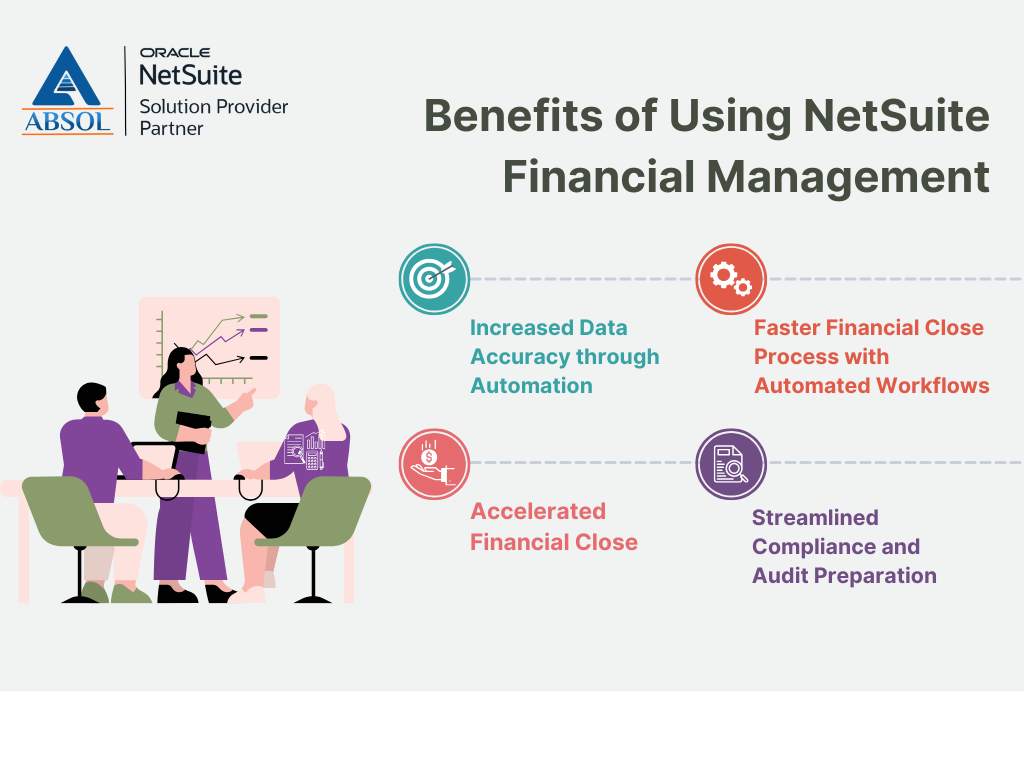
3. Benefits of Using NetSuite Financial Management

A. Increased Data Accuracy through Automation

Manual data entry is time-consuming and error-prone. With NetSuite, repetitive processes like invoicing, journal entries, and reconciliation are automated, significantly reducing the likelihood of human error.

         Seamless Integration: Financial data flows automatically between NetSuite modules, ensuring consistency across accounting, procurement, and other departments.

          Fewer Errors: Automation ensures that calculations and reporting align with the latest data, minimizing risks and maintaining data integrity.

By reducing manual intervention, businesses achieve higher accuracy and can better focus on financial analysis and strategic initiatives. The reliability of financial data is paramount for making informed decisions, and NetSuite provides the tools to ensure that data remains accurate and trustworthy.

B. Faster Financial Close Process with Automated Workflows

Closing the books at the end of a financial period is traditionally a labor-intensive process. NetSuite speeds up this process through automated workflows that handle complex financial activities, such as:

         Revenue Recognition: Automatically aligns revenue with the appropriate accounting period, ensuring compliance with revenue recognition standards.

         Expense Management: Tracks, categorizes, and records expenses seamlessly, providing visibility into spending patterns.

         Multi-Entity Consolidations: Consolidates financial statements across multiple subsidiaries without manual intervention, reducing errors and saving time.

           How Automation Streamlines the Close Process: The automated close process significantly reduces the time required to finalize financial statements. By eliminating manual checks and balances, NetSuite allows finance teams to focus on high-value tasks rather than tedious data entry and reconciliation. The result is a more agile financial close, enhancing the organization’s ability to respond to changing market conditions and making timely, strategic decisions based on accurate data.

C. Accelerated Financial Close

NetSuite’s robust automation capabilities empower businesses to significantly reduce their financial close cycle. By automating routine tasks, streamlining workflows, and eliminating manual data entry, NetSuite can help you achieve a zero-day financial close and reduce your month-end close time by up to 40%. This accelerated process ensures timely and accurate financial reporting, enabling data-driven decisions and improved business agility.

D. Streamlined Compliance and Audit Preparation

Compliance with regulatory standards such as GAAP, IFRS, or SOX is essential, but it can be challenging to manage manually. NetSuite simplifies compliance by integrating controls and audit trails into everyday financial processes.

Key Compliance Features:

          Role-based access controls to ensure that sensitive data is only accessible to authorized personnel.

          Automated checks and balances to reduce fraud risks by establishing a clear audit trail for all transactions.

           Built-in compliance reporting to simplify audits, making it easier for organizations to demonstrate compliance during financial examinations.

NetSuite reduces the stress of preparing for audits and ensures businesses stay compliant without additional administrative overhead. Organizations can quickly generate the necessary documentation and reports required for audits, allowing them to focus on core business activities rather than compliance-related tasks.

4. Integration with Other Business Functions

NetSuite’s financial management module doesn’t operate in isolation—it integrates seamlessly with other business functions, such as inventory management, CRM, and procurement. This ensures that financial data is updated automatically across departments, creating a unified view of business operations.

Examples of Cross-Functionality:

        CRM Integration: Sales transactions entered in the CRM instantly reflect in the accounting module, ensuring accurate revenue tracking and reducing the risk of discrepancies.

        Procurement and Finance Alignment: Approved purchase orders trigger automated payments, minimizing delays and improving cash flow management.

         Inventory Sync: Inventory levels are continuously monitored, and the system updates financial accounts in real time, ensuring accurate cost tracking and reducing stockouts.

This interconnected structure eliminates data silos, reducing duplication and ensuring more accurate reporting. The synergy between departments promotes collaboration and enhances overall organizational performance.

The Role of Real-Time Data in Cross-Functional Integration

Real-time data integration allows organizations to operate more cohesively. When different departments can access up-to-date financial information, they can collaborate effectively, anticipate challenges, and adjust strategies accordingly. For example, sales teams can make more informed decisions about promotions based on real-time sales data, while finance can ensure adequate cash flow to support those initiatives.

5. How NetSuite Improves Efficiency

Efficiency in financial operations is about minimizing manual processes and accelerating key activities. NetSuite enhances operational efficiency through automation, streamlined workflows, and improved reporting tools.

A. Automated Workflows

Pre-configured workflows eliminate the need for manual approvals and data entry, freeing up time for strategic work. Automation allows businesses to handle a higher volume of transactions with ease, leading to improved productivity and reduced operational costs.

Example of Workflow Automation: Approval workflows for expenses can be configured to automatically route requests to the appropriate manager based on predefined criteria, reducing delays and improving accountability.

B. Pre-Built Reports

NetSuite provides pre-built financial reports that can be quickly customized, reducing the time required to generate key reports. These reports are designed to meet a variety of business needs, from high-level overviews to detailed analyses.

Standard Reports Include:

            Profit and Loss Statements: Analyze income and expenses to determine profitability.

           Cash Flow Forecasts: Project future cash inflows and outflows to manage liquidity effectively.

           Variance Reports: Compare actual performance against budgets to identify discrepancies.

With these pre-built reports, finance teams can spend less time on data gathering and more on analysis and strategic planning.

C. Expense Management Modules

NetSuite’s automated tools streamline reimbursements and employee expenses, saving time and reducing errors. The expense management module allows employees to submit expense reports electronically, which can be approved through automated workflows.

Benefits of Automated Expense Management:

        Faster Reimbursements: Employees receive their reimbursements quicker, enhancing satisfaction and compliance.

        Expense Tracking: Detailed tracking of expenses helps businesses understand spending patterns and budget accordingly.

         Policy Enforcement: Built-in controls ensure that all expenses comply with company policies, reducing the risk of fraud.

By integrating expense management into the financial workflow, businesses can gain better control over spending and improve overall financial performance.

6. Why Choose NetSuite for Financial Management?

Choosing the right ERP system directly impacts how efficiently a business manages its financial operations. NetSuite stands out as an ideal financial management solution for businesses looking to:

         Enhance Data Accuracy: Automate financial processes and reduce human error. NetSuite’s automation features ensure that financial data is consistently accurate, reducing discrepancies and improving reporting quality.

         Simplify Compliance and Audit Preparation: Leverage built-in controls and audit trails to stay compliant. NetSuite’s compliance features make it easier to adhere to regulatory requirements without adding significant administrative overhead.

         Improve Financial Visibility: Use real-time reports to monitor financial performance and make timely decisions. With comprehensive reporting capabilities, NetSuite enables businesses to gain insights into their financial health at any time.

        Integrate Financial Operations with Other Departments: Benefit from seamless data flows across departments for more accurate reporting. NetSuite’s integrated approach allows for a holistic view of business operations, reducing data silos and improving communication.

Conclusion

NetSuite Financial Management offers a comprehensive solution for businesses seeking to enhance accuracy and efficiency in their financial operations. By automating processes, integrating with other business functions, and providing real-time reporting, NetSuite empowers finance teams to make data-driven decisions and respond rapidly to market changes.

The capabilities of NetSuite not only streamline financial activities but also reduce errors and improve compliance, ensuring that businesses can operate confidently in today’s complex financial landscape. With the right financial management tools, organizations can focus on growth and innovation rather than being bogged down by manual processes and compliance burdens.

Investing in NetSuite is not just about software; it’s about transforming financial management into a strategic advantage that drives your business forward.

Call to Action

Are you ready to revolutionize your financial management processes? Contact ABSOL today to learn how NetSuite can enhance the accuracy and efficiency of your financial operations and drive your business toward greater success.